
The First March data is in, so time to report on the progress of sea ice formation so far this year and, it has to be said, it does not look good. But remember, this is weather we are looking at, not climate. That is the best I can say. but fear not. It is not catastrophic. What it is, is the lowest level of ice formed at this point in the year, out of all the 40+ years of satellite records.
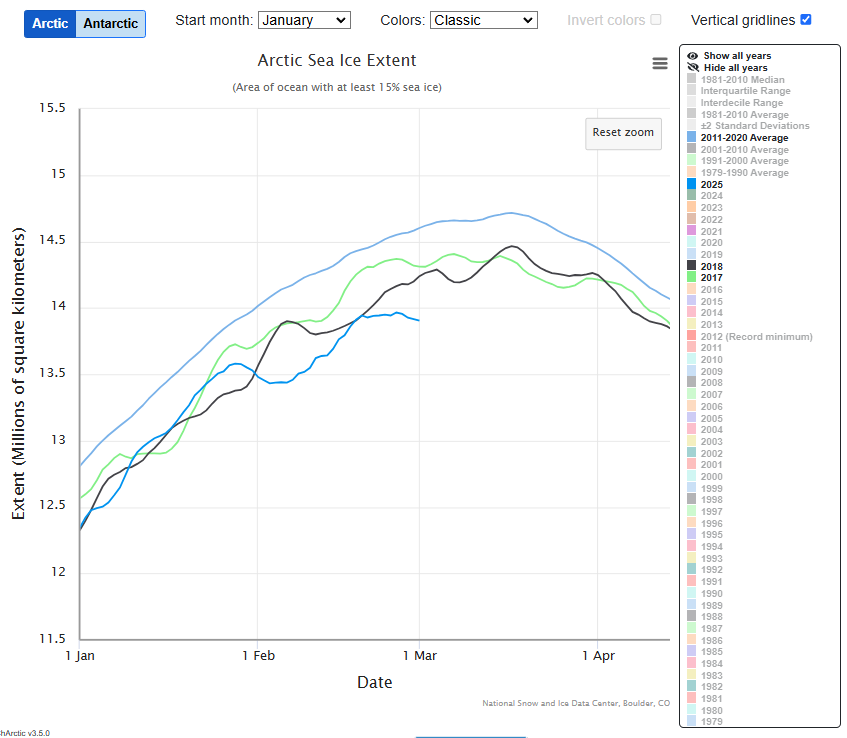
The chart below shows the 2011-2020 decade average (fainter blue line), which is our base line for comparison with the current decade. The green and the black line are for 2017 and 2018 respectively, and it can be clearly seen that this month (brighter blue line, for 2025) has barely reached even the lowest point of either of those lines for the whole month. I wish I could explain that, but I don’t have the weather details which could possibly do that.
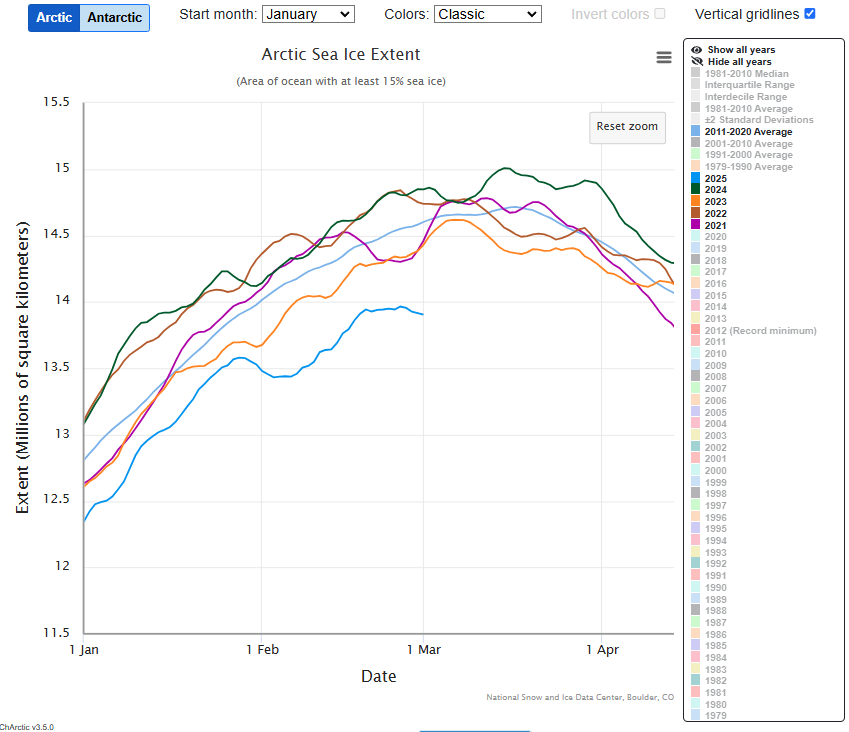
Anyway, this has not drastically affected the averages for this year. If we look at the updated spreadsheet, 13,904,000 KM2 of ice were floating on the Arctic Ocean at the end of February, giving an average for this decade (5 years) of 14,479,000 KM2. Which is 149,000 KM2 less than the average for the previous decade at the same date of the year. So, little damage has been done, even though it looks bad, as seen in the bottom chart below. This is the beauty of averaging weather results over a reasonable period of time, such as a decade.
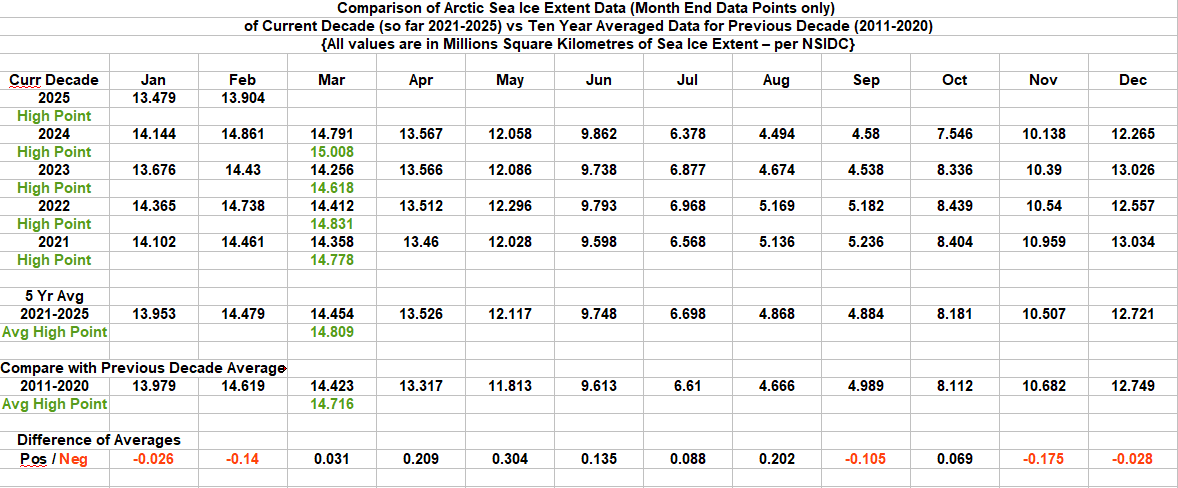
The difficult thing is that this is now four months straight of negative results. That never happened at all in the previous 12 months. Nil desperandum. The highest point in the ice formation season is nearly always during March. And even though the start point is nearly always higher than the end point of that month, last year, 2024, ended just a little bit higher than it started, and the peak was the highest for this decade so far. That may not happen this year, but since we started from such a low base, it is possible that we may end up closer to the previous decade average than the current state gives us reason to believe. Wait and see.
Let’s just recap on why I am doing all this in the first place.
My theory is that reading from background climate conditions, it is possible that the current warm inter-glacial period, which has been in effect from the time of the rise of modern humanity, is ending. Some climate experts in a new report, as I reported yesterday, believe that a new glacial minimum (or glacial ice age) is due to start in about 10,000 years. And for that to happen, more ice needs to be built over Winter, while less ice melts over Summer. My contention is that the current decade shows signs of that happening right now (remember we are talking averages, not individual years). A conclusion made from observation before that new report was issued. And I intend to follow this through to the end of the decade to see if it holds together. It’s a long shot. I admit that. But if climate change is predictable as those experts say, it could be predicted now, rather than waiting another 10,000 years.
In effect this means that the records for the current decade, which appear to be similar to the previous decade, show a complete slowdown or absolute stoppage of the trend to rapidly advancing ice melts of some million KM2 per decade over the past two decades (representing a ‘peak’ condition). That is still on the cards as far as I am concerned, from this decade’s data so far. Hence my interest to see whether it continues or is merely an interim phase of the process.
But if, as they say, it is 10,000 years to the next glacial minimum, that would be a rapid cooldown. The usual time for such is 100,000 years, not 10,000 – unless it will be one of the incomplete colder phases which occur from time to time, in between the major peaks and troughs. My theory of an imminent start to the cooldown from the current peak, requires that there will be the usual 100,000 years of gradual cooling. Although, as I said yesterday, I don’t have the data from which they say these things can be predicted.
Whatever the case may be, this is clearly the end of the ‘runaway climate catastrophe’ and ‘irreversible trigger points’ so beloved of the alarmists. If such were even possible, then clearly there could be no predictability to any of it. Could there?
I will leave it there …and keep monitoring.
Oh, as usual, thanks to NSIDC, for making any of this possible.


Leave a Reply