
For a number of years now, I have shown month by month that when it comes to Arctic Sea Ice – the once darling choice of the Catastrophic Climate Change mob – there is actually nothing much going on to talk about.
My theory, not yet proven – and won’t be until all the data (not unrealistic forecasts) is in, is that there is nothing to concern humanity going on up there in the cool seas of the Northern ocean. This certainty may not occur for several decades in the future, but current indications demonstrate that there is no expansion of sea ice melt going on for at least two decades now. This is in spite of the fact that, in two previous recent decades, about a million square kilometres of sea ice was lost from Arctic seas per decade over the Summer melting period. But that also, though, is quite misleading, because only half of that loss amount was not recovered in following Winter ice build up processes. Of course, it is not in the interests of certain parties, for us to be made aware of that.
Nor are we told that for the past two decades no expansion of sea ice loss can be seen at all. It is as though a halt has been called, resulting in a steadying of the status quo. Why might that be?
Well, the whole position taken by climate extremists is actually made on very shaky grounds. Global warming, except on very a very short timeframe, is non-existent. Warming and cooling periods happen all the time and the most recent one, over the past 50 years or so, is not as warm (by at least 1 degree Celcius) as other periods over the past 10,000 years. That peak was reached early on in the more or less 120,000 year cycles of such things, between 10 an 8 thousand years ago and has since slid down to be where we are today – at the lowest point in the warming cycle. The next scheduled event, and yes, these things can be regarded as being scheduled, or inevitable (barring overriding cosmic tragedies, which we have no real ability to predict), is a return to the long term cooling (by up to 5 or 6 degrees Celcius) trend – as our planetary history clearly shows.
We should totally disregard the inappropriately named ‘Little Ice Age’, which was nothing of the sort, with average temperature falls of no more than around 1 degree Celcius. A 5 or 6 degree fall will be noticed, not by all but by many people living at high latitudes and perhaps requiring some population movements to accommodate those extremes. But, fear not, this will not be for us, nor for many generations of humanity yet to come. Neither will this be a new ‘ice age’ but the continuing cycling of life at the bottom end of the planetary temperature envelope that we have been sliding into for tens of millions of years now – making further nonsense of current ‘global warming’. Of course only the most ancient of modern humans ever experienced such conditions. It is actually out from such times that our modern civilisation arose – not that folk living in our tropical regions ever felt those frozen times. Nor will they in the future. And that – lack of prior experience (other than ancient memory) – is probably at least partially behind he reasons for our current hysteria on climate issues. Most of us have grown accustomed to a mainly comfortable existence within that central belt of the planet. And, you should be aware, that is not going to change. Perhaps for ever. While there is talk of an earlier ‘snowball Earth’, such conditions never existed. The central belt will always be a refuge for humanity.
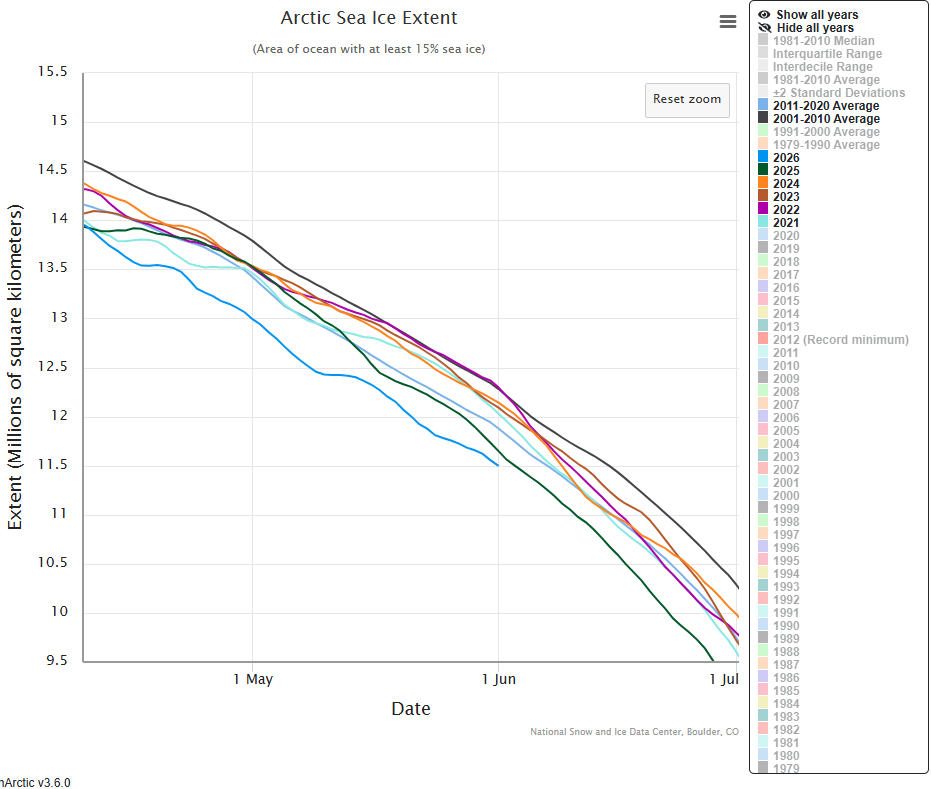
I will leave that there. Here are current sea ice charts from NSIDC.
The blue data line for 2026 is trailing the pack of years of the current decade but it is easy to see that four of those 6 years are above the average line for the previous decade. And so the average for the current decade, so far, as at the beginning of calendrical Summer (June 1), is actually above that of the previous decade…
…and when we add in the last 5 years from that earlier decade, and 4 of those 5 years are actually below the average line for their own decade. Only one is above it. And 2016 is the all-time (modern) bottom of the pack.
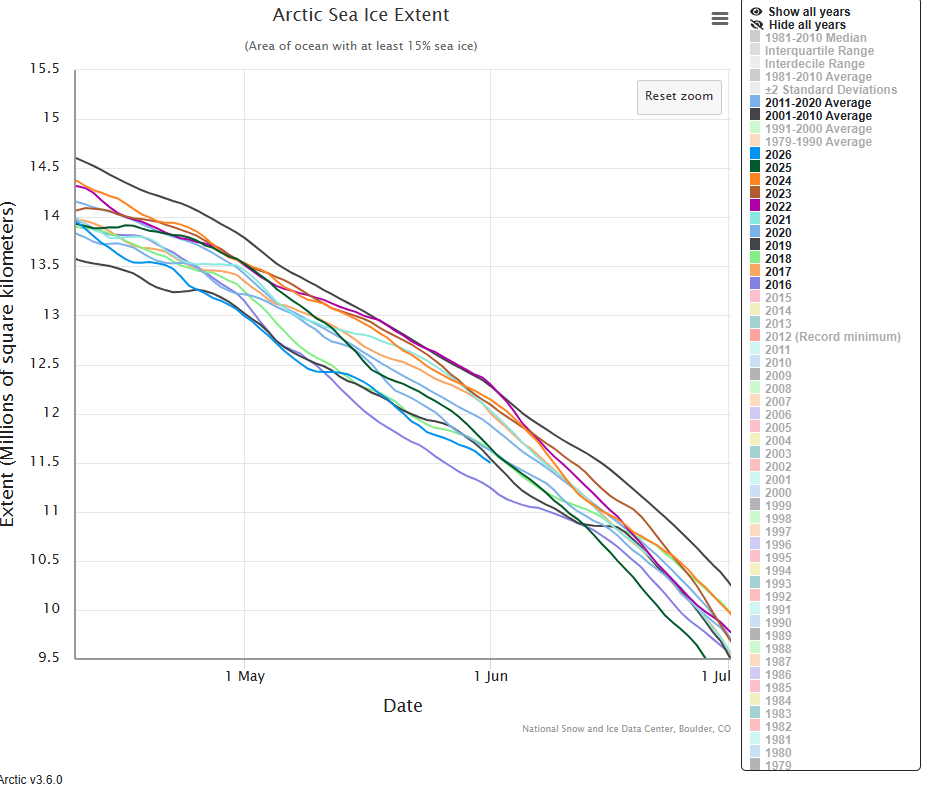
I would say that this is clear evidence, at this point in time, that nothing of concern is going on up in the Northern seas. And I fully expect that to remain the case for the second half of the year.
What it does show is that there is considerable variance in the data from year to year, which is why we, and all realistic parties, only discuss the situation within the context of decadal averages. It removes the guesswork, and potential thought bias.


Leave a Reply