
Except… and I have added this paragraph to the top of what I had already prepared for this post in the first few days of this month – January. I don’t have time to investigate fully but I am aware now of discrepancies within the data NSIDC stores in its spreadsheets of daily sea ice data and what is recorded in its charts. Whoever is responsible for that must either be an incompetent statistical data recorder or they must employ poorly trained monkees as chartists. Alternatively I suppose it could be due to US rudimentary level Artificial Intelligence, having run out of real statisticians. Whatever the case, I am not going to change anything even though I now have awareness of the inconsistencies, and who knows what dataset is correct, if any. I have always built my investigations on the NSIDC charts, but I am unsure just what I will do going forward. Not that the discrepancies make much difference to the overall balance of climate change inferences regarding sea ice. Those are already baked into the cake, more or less, as being what is expected to occur as a result of past experience, but it is the principle that counts. Either there is assured integrity or no integrity at all. I may go into this more fully at a later date.
As for now, the “something that brings an air of warmth” is missing. I don’t find any ‘warmth’ coming from anything which comes out of the US at the moment. But I still have a lot to say in the lines below.
This post begins here. All that is written below was laid down by January 3, 2026. It is unchanged.
For decades now, climate alarmists have forecast – not at all accurately – worsening events to come for the inhabitants of our planet. It is good to be able to say that not a word of that is true. There are no dire consequences to be faced from rising temperature, rising seas, receding ice formations, looming droughts, increasingly frequent violent storms, stronger winds or drying lands. To the contrary, all of these things, none of them being factually based, are broadly going in the opposite direction.
I say broadly, because in the case of sea levels, apart from anything else, a number of recent reports indicate (and yes, I know, this is not a scientific evaluation) a number of sea-going vessels have been grounded on sand-banks. That just would not happen if seas were rising like we are being told. There is also much more acceptable evidence of course, to add to that.
In all of these listed ’causes for alarm’, there is also much scientifically measured evidence to refute that case. For some reason – sounds suspicious, because it is – those arguments are not being aired to global society in general. Even though, with the passage of time, the alarmist case is growing ever thinner, its ‘authoritative’ case evaporating. Someone is going to have to answer some very awkward questions before too long, about wasting (and pocketing) the wealth of nations in fatuously madcap schemes that were never going to yield any gains or safety from ‘fighting’ imaginary climate woes.
So, if what I am saying is true, what evidence is there to show that? Well, we don’t actually need any fresh evidence since such evidence as is needed, is already there in the scientific record. We just need to shut down all the false voices proclaiming deliberately misinterpreted or entirely fake data. Such voices are usually authoritative in nature and therefore carry some weight. That is really the only reason they have prevailed to paste an incorrect image of the situation into our minds. And yes, I freely admit I was mind-pasted too for quite some time. But gradually that image didn’t seem to make sense. Do you feel that sometimes? There are many other voices, I assure you, which do represent truth as it was meant to be portrayed. I urge you to look for them if you are still confused.
There are areas of visibility which ordinary folk like you and me can check for contrary evidence we might logically expect to see (logic which offers different results to those we are told currently exist if the broadcast general theory we are being sold by those who seek to convince us we are in some sort of mortal danger from the planet which has sheltered and preserved us and other co-existing life-forms for as long as we, or they, have existed here), does not hold water like it reasonably should be expected to do if it were actually true. And by ‘areas of visibility’ I mean situations which ordinary folk like ourselves can scrutinise using the most simple logic we possess, without recourse to mathematics or statistics or any other scientific gobbledegook (essential and heart-warming as that may be as backup to our own more intuitive reasoning) to form an intuitive position of our own on those subject matters. I can feel scientists wincing as I write this (if they would even bother to have read this far, or if anybody at all has bothered to read this far). People are generally too ready to grant acceptance of voices of authority in such matters, no matter how feeble their credentials, and too lax in understanding to grant the same freedom to scientific voices raised – or more often not raised – too far in opposition to those authoritative views. Simply because they do not possess much understanding of the value of arguments presented. Murder and other dire consequences are often overlooked as a result. And neither science nor authority seems to care about the scandalous results, caught up as they both are in their own separate worlds. In order to break this apart, and perhaps even to survive some situations, the general public needs to at least possess some rudimentary interest in what goes on around them and a basic understanding as to how they can reason for themselves an acceptable outcome. Sometimes I wonder just how we have managed to stumble through the many traps laid for us over the years, not least of all in this modern world, by unscrupulous groups bent on improving their own lives at the expense of ours. But the stakes increase as the years go by. It behooves us to begin to think clearly and take part in protecting our own futures by honing our intuitive senses around what we should be able to see for ourselves and what we are told we are going to be seeing if we don’t do this and that, which on the face of it are meaningless gestures which could never work but are set to impoverish us.
One of those major, and perhaps most visible, climate features we can use to see what is really going on would be the state of sea ice, particularly Arctic Sea Ice. Nothing of any importance is going on down south in the Antarctic, since those fields were laid down from around 30 million years before there was any ice in the Arctic and temperatures at that time were considerably higher (around 22C [long term global average] according to the scientific record) than when the Arctic ice formed less than 10 million years ago (below 17C by the same measure). Today we are at a little under 12C long term global average temperature (again relying on the validity of data from the best scientific sources), on the way to a more than adequately precedented basement level of around 10C before it once again begins to rise, some millions of years in the future, so there is little chance that either polar ice masses (North or South; sea or land) will disappear any time soon. And if, as we are told, these things are going to happen soon, what accompanying conditions should we be seeing? And are we actually seeing those conditions? And, if the prevailing climate situation is not showing such dire conditions, but something much closer to what we know as normal, how should we react to the lies we are being told?
So, returning to the present, where do we stand at this important juncture of a year-end, particularly one resting half way through a decade of reporting of results for Arctic Sea Ice? Well, the following banner announcement appeared on the NSIDC Sea Ice page today, or recently…
Sea Ice Today tools and services have been reduced due to non-renewed funding. Learn more about what this means for users here: https://nsidc.org/data/user-resources/data-announcements/user-notice-sea-ice-today-services-reduced
There was a similar announcement of service disruption, actually service ceasure, back in July of what is now ‘last’ year. That temporary or permanent pause was overcome by the use of an alternate information source I believe. But this sounds to be a bit more of a permanent stoppage. Why is it that important information sources, especially ones where the data does not conform to modern climate alarmist expectations, is under constant threat of erasure? I think we know why. The world’s peoples must be kept in the darkness of a murky non-solution field of foggy-mindedness if the plans of ‘those who rule’ are to succeed. Heaven forbid that folk should get to know what is really going on seems to be the base reasoning of authority – whether local, regional, national, or global.
…and, what is going on? Many people I think are now aware that what is being relayed, everywhere and continually, does not match the data reported by science. This is one such case.
In the images below of the end of year situation on Arctic Sea Ice – we are now in the middle of the latest Winter sea ice growth period – and my monthly, end of year (mid point of current decade), spreadsheet of results, a new message is forthcoming, in real time, with every month and year that passes, to further reinforce the ideas I stated earlier.
Here is the NSIDC graph (selected to focus on the final week of the current month, and the whole year as compared to the previous decade)…
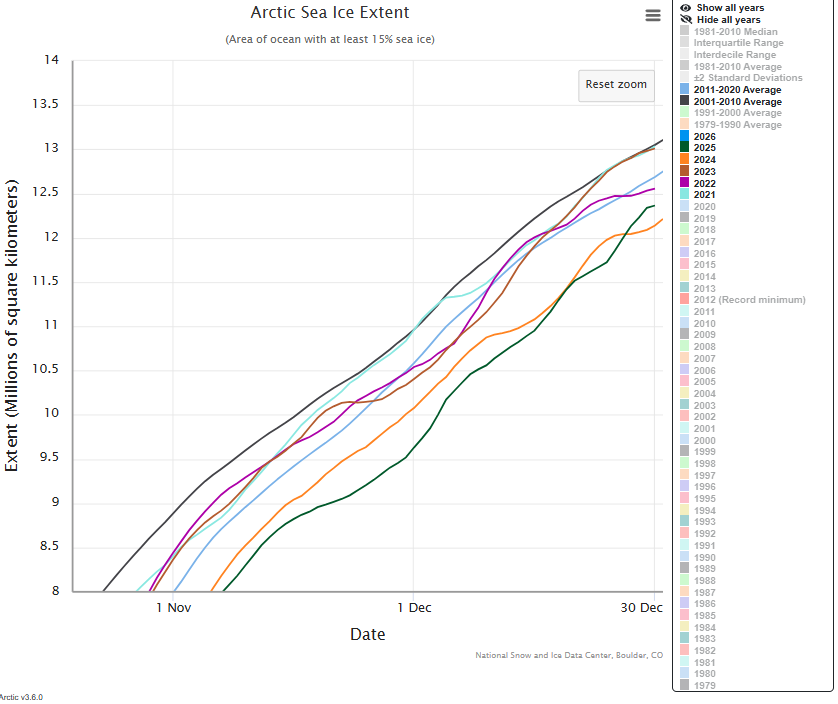
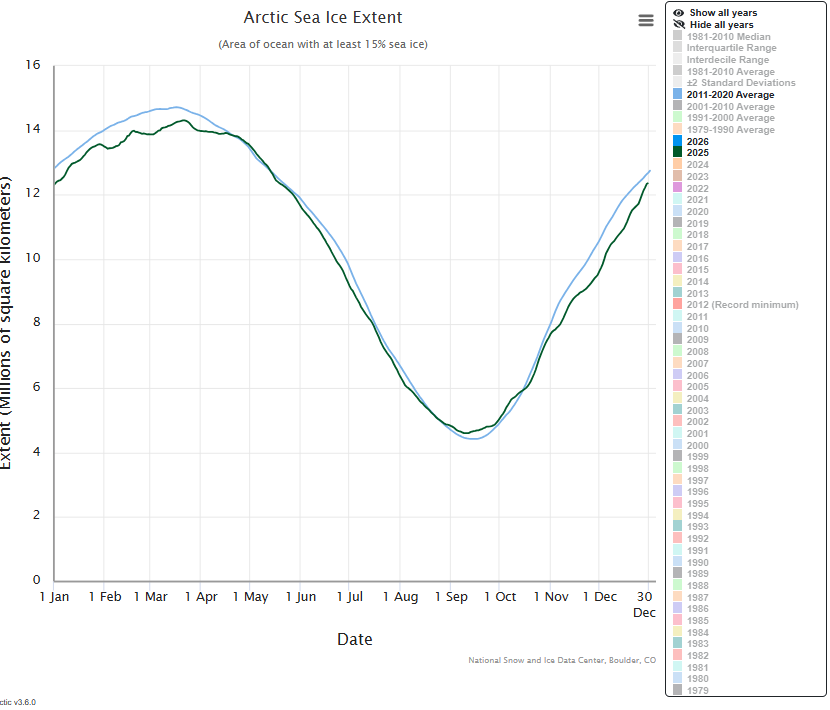
We should not consider any single year’s data to be significant in itself due to sometimes considerable annual variance from short-term weather patterns across the seasons (I repeat this from time to time because it is important). Scientific sources seem to consider data averaged over complete decades to be the minimum period where patterns of change may begin to emerge, and this is reflected in the reporting by NSIDC. But I think it may be valid to look at the first five years (the point in time at which we now stand) of any decade to provide some indication as to what may occur during the remaining second half of the decade. How fortunate that we can do this right now. The glimpse is risky, things could change, but we are impatient beings and if we can satisfy ourselves at the thought of where things might be in five year’s time, we may be able to move forward with hope more freely, or with time to make possible alternative plans. This is not forecasting, and it involves no modelling. It is projecting the most recent past as best typifying expectations for the most current future (and no more than that), while being fully aware of the risks involved in making such projections. A much sharper prospect than simply crossing fingers and toes or relying on modeled climate data.
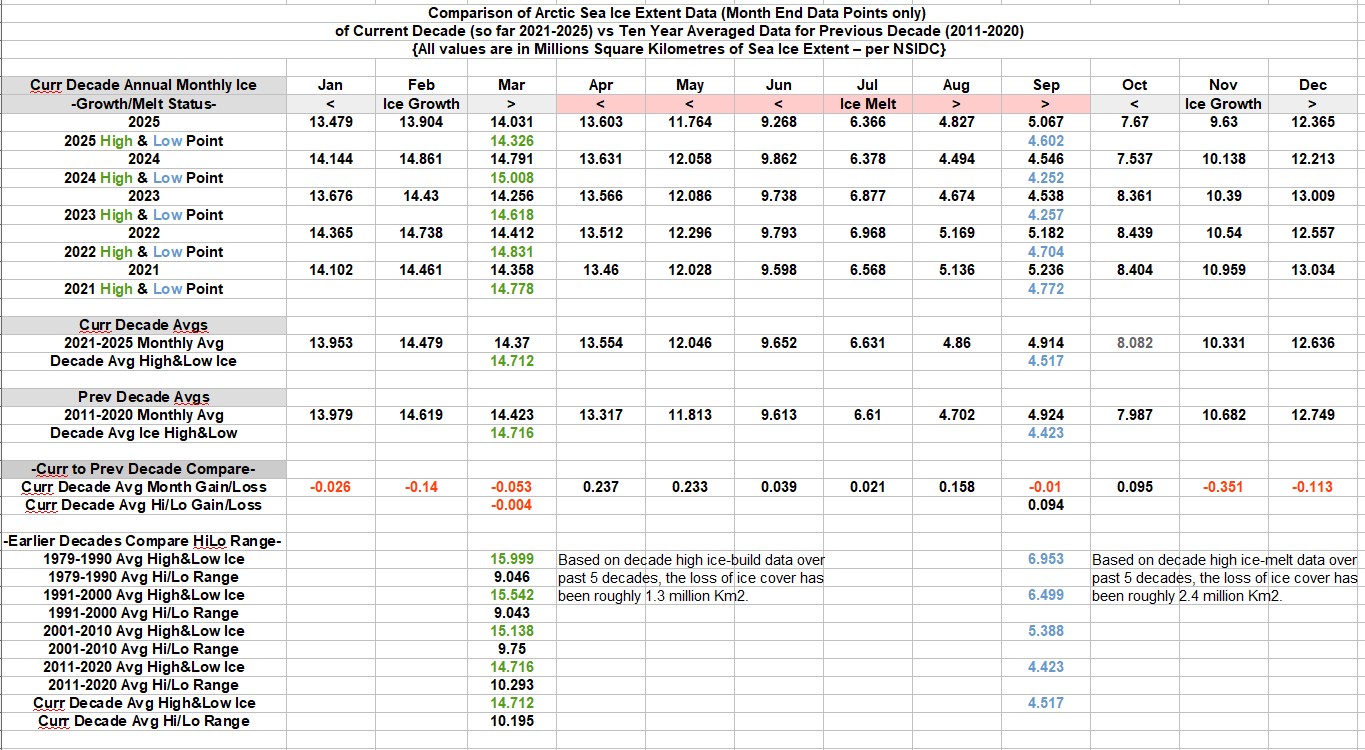
Here we can see that it was not until the final few days that 2025 showed any real promise of a better start for 2026 than was inherited by itself from 2024. But the most remarkable thing about 2025, visualising the data in the spreadsheet below, is that the year (after being given a poor start from 2024), intertwined itself about the previous decade average for the rest of the year. Half of which was spent above the average line and half below, in terms of the twelve monthly comparison points which is as far as I am willing to go to calculate this. The result confirming (to some extent) that previously expanding sea ice loss has now ceased entirely. If this continues for the second half of the decade (very possible , and expected, due to historic climate data over the past several hundred thousand years, backed by climate patterns over much longer periods than that), then we are provided with increasing hope that those both medium and long term patterns will continue to recur (with minor variations of course) for millions of years to come. What an exciting prospect, and one which would make our current century efforts at climate adjustment look rather foolish and our recent generations of humanity to appear as quite stupid and not in the least bit scientifically driven to the hind-sight gaze of our future descendants.
And here is the completed spreadsheet to end of 2025, which confirms what I said above…
I’m done here, for now.
 Not Something Else
Leave a comment