
The visuals of climate change (how you see it) differs so widely between folks, the majority (because they have not put too much effort into discovery for themselves) taking their views ‘second-hand’, and even some very intelligent people (who should know better), all get it completely wrong. The criminal elements who trade in the dissemination of lies on the subject – chief spox of them being UN’s Guterres – are now threatening criminal proceedings and jail-time for the brave folk who are trying to turn the tide of establishment lies to something closer to the truth. That includes academics, geeks and non-geeks (like me). I think of myself as a non-geek but I am afraid to look up a definition of the term, in case it is me.
The most egregious lie about climate change being that pure, sweet you and I – human beings – going innocently about our daily practices, are all responsible for the problem. A problem which does not actually exist in nature, but only in the minds of the criminal element who generally have the most say and sway within our social hierarchies. Well not even there either (in their minds, that is), but it is the excuse they use, believing it or not, to beat us about the head for our perceived transgressions against nature – and getting us to do stupid and unhelpful things like buying Electric Vehicles and collecting plastic, paper, glass, and other stuff which can make other people rich, as a virtually free source of input material for their businesses.
So, what do we do about it?
We learn the truth of course. Being very careful to choose reliable sources. Like from geeks and not so well known academics who are on the right track. Don’t expect that to be easy.
What is the biggest error in climate thinking?
I would say – because that is what I want to talk about here – that it is the variable content of the air we breath.
Except, what all tend to forget – especially those who go on about the increasing levels of GHGs (Green House Gases) in the atmosphere – is that the content of air is invariable. Read that again. It is true. Well, except for very small and inadmissible amounts, over very long periods.
Like, for instance, Carbon Dioxide (CO2) used to be – in recent times – at around the level of 300 parts per million (ppm), or 0.03% of the atmospheric gases. It was, over the past couple of million years, even lower than that at around 0.018% of the air content and is now sitting, and growing slowly, at around 0.045% (450 ppm). Which has tended to alarm certain people. The same people who want an excuse to punish humanity for perceived sins against nature.
CO2 in Perspective
I should add here that this is a low point for atmospheric CO2. A very dangerous low point. A few more millions of years ago, CO2 levels were at between 1000-2000 parts per million (ppm), or 0.1% to 0.2%. And tens of millions of years ago they were at 3000 ppm, 0.3%. That was the highest point, to our knowledge, they have ever reached. Even back then, at a top of less than one third of one percent of atmospheric gases, that was an infinitesimal variation from what we have today. The atmosphere has remained largely the same as it is now, across all those tens of millions of years. And suddenly, CO2 is being perceived as a problem – because we came along. The climate alarmist CO2 issue is shown to be pure Bullshit.
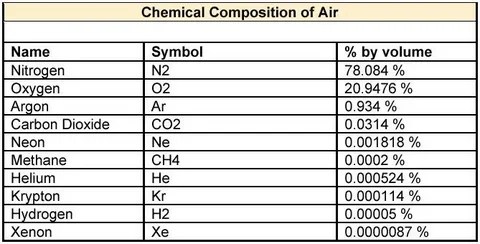
Here is an image which I use when talking about atmospheric content. It is not up-to-date (still shows 314 ppm for CO2), but since the ratios of gases have not markedly changed over millions of years, that is of little consequence. There are a number of things I want to say about this. If you total the percentages of the top three gases, they come to 99.9656% of the total atmosphere, leaving only some 0.034% for CO2 and all the remaining ‘trace gases’ – of which there are around 40 always present. The ones that are worth measuring, are those listed – though some try to make a case for Nitrous Oxide as being a GHG, and it does not even make an appearance here.
You can see, I hope, that any puffing-up of the role of CO2 in climate change is both futile and irrelevant. And yet it does have a place. A very important one. More on that perhaps later.
The only way that CO2 could prove to be a danger, is if it clumped in large amounts in various spots within the atmosphere. It is obvious, I hope, that we are not talking about the normal content of atmospheric CO2.
OK, I’ve done enough talking for this section. I promised you geeks. Here they are…
Ourselves and Plants – A Symbiotic Relationship
‘Gasses We Breathe In and Breathe Out | Composition of Air’ – Geeks for Geeks – April 17, 2025
…see, I told you they were Geeks. They spell Gases with three ‘s’s. Ohh… yeah… I guess that must mean I am not a Geek. Happy Days!
Seriously though, I have included that article here because it does contain some, actually quite a lot, of fresh information for perhaps quite a lot of people, most of which is related to the gaseous make-up of our atmosphere. Which more or less verifies what I have said here. But there is one thing I want to warn about. In their abbreviated list of gases in air, they include the three majors plus Carbon Dioxide and Water Vapour (which is not an atmospheric gas – more on that in the next section). They list, against each gas, the amounts we inhale and exhale. Although the amounts of CO2 are again out-of-date. Should be 0.045 (450 ppm). In any case, it is easy to sea the relationship between ourselves and perhaps the major living genera of Earth – the plants. Without which we would not be alive. Perhaps would never have been alive. So be kind to plants, we need them.
We breathe in all the Oxygen content of the air that fills our lungs and breathe out again around 80% of that. We breathe in all the CO2 of the air that fills our lungs and breathe out considerably more that than. The clear meaning of that being we convert some of that Oxygen to CO2. Obviously there are a great many interchanges of such gases, producing a balancing effect for the atmosphere, otherwise our air would quickly become unbreathable – as we know happens if we find ourselves within a sealed container. One of those interactions occurs during the breathing of plants (yes, they do breathe – Do Plants Breathe?). Plants do the opposite to humans. They inhale (for want of a better word) CO2 and exhale Oxygen. Not necessarily in the same reverse ratios as we do, but overall, in the mixture of at least partially symbiotic interchanges, a balance is preserved.
This gives the lie to the warblings of climate alarmists about the ‘dreaded’ but totally inadmissible human ’emissions’ illogic. I hope you see that.
No matter what emissions are raised, or by what or whom, or from where, they always find a ‘home’ or repository of some sort (like producing more, or reducing some, plant growth). They never change the composition of our atmosphere.
Why Earth’s Atmosphere Can Never Change
Now, I admit that I do not know much about the subject discussed in the following article, although it seems to be logically based. And I have left myself with little time to make comment – perhaps some other time. So I will just pop this here for your own serious reading, glancing, ignoring or whatever.
I feel sure there must be something to it, anyway, so I have extracted the Conclusion, below, to stir your interest.
In conclusion, the absence of density stratification of the gaseous components of air is due to a combination of factors. The ideal gas law, which governs the relationship between gas density, temperature and pressure, ensures that density changes in the Earth’s atmosphere are gradual and continuous rather than abrupt. The processes of mixing, diffusion and turbulence also contribute to the uniform distribution of gases, preventing the formation of distinct layers based on density.
The lack of density stratification in the air is an important characteristic that distinguishes it from many other substances. This unique behaviour has important implications for atmospheric dynamics, weather patterns and the overall functioning of the Earth’s climate system. Continued research and investigation into the intricacies of air’s composition and behaviour is crucial to deepening our understanding of Earth science and its implications for the future of our planet.Conclusion extracted from the article linked below, in the Geoscience Blog.
‘Unraveling the Mystery: The Absence of Density Stratification in Air’s Gaseous Components’ – Geoscience Blog – May 9, 2024
 Not Something Else
Leave a comment