
It’s that time of the month again. Arctic Sea Ice Extent level for end of May 2025 is in. And it is pretty much as expected, with all recorded years generally producing roughly the same sea ice levels, at this point in the annual cycle, no matter what occurred in the earlier months of Winter, nor – of at least similar importance – what may occur in the later Summer peak melting season.
And it is important to note, that whatever the upper and lower boundaries of annual sea ice variability may be – and they have never differed by a significant amount (no matter alarmist claims) – during the satellite era, varying from peaks of between 16 million KM2 and, more recently, more than 14.5 million KM2, and down to troughs between less than 7 million KM2 and less than 4.5 million KM2 – giving a steady range of annual movement between those peaks and troughs of just 9-10 million KM2 over the whole of the 47 years of satellite measurements (by decadal averages) and a net loss of sea ice of just a little over 1 million KM2 across the same period (the difference between peak and trough variability).
[This is always assuming, of course, that we accept the accuracy of such measures as we have today. Which being all that we have available, of any value and covering modern times, means we either ‘zip our gobs’ and remain in quiet ignorance, or we accept and base our musings on that information, without embellishment. At best, we should accept the data , as is, adjusted, as it is from time to time, with certain minor reservations about its absolute accuracy.]
And that net loss just a little over 1 million KM2 of sea ice is no longer growing. Nor should it be expected to grow, now that the inter-glacial period of the past 17,000 years has run its course (during this very decade, I believe).
It will not take much cooling at all, now the conditions are changing (or will change, if my beliefs prove to be a little premature). We will soon be entering a new glacial period, to first reverse that small net loss of sea ice and in fact to begin the obvious fresh further encroachment of ice coverage over the whole of the Northern ocean and eventually covering much of the Northern land masses which surround it, just as it has in the not too remote past. The last such encroachment having occurred following the previous inter-glacial period, around 120,000 years ago. These things can generally, and logically, be rationally viewed as cyclic in nature, you see.
To be reasonably precise about what we have observed within the satellite era, what has been happening in that time – mirroring what occurred in the distant past – is that every year, April loses ~1 million KM2 to sea ice melt from the March peak of ice growth. May loses ~1.5 million KM2, June loses ~2 million KM2, July loses ~3 million KM2, August loses ~2 million KM2. That is always the case, without fail. Any remainder of the 9-10 million top-bottom, Winter-Summer range value which I mentioned earlier, being taken up among these monthly approximations, plus changes in March and September which are both viewed as turning point months. That is ‘every year’ by decadal averages of course. Individual years plot their own courses (like 2012 and 2025), producing deviations which of course get wrapped into the longer term averages.
It is Swings and Roundabouts ladies and gentlemen, or cycles, if you prefer. If you see anything different, you have been conned.
What does this mean? It means that we never lose more sea ice – no matter the weather, than we approximately regain the following opposite season. It is a cycle, pure and simple. Never varying from the up to 10 millions of KM2 in range value nor by more than 1 million KM2 in peak or trough (again by decadal averages). It would be foolish to deny there has been no loss of sea ice over this period, because the data shows that there has. In fact, if you take the max/min values for 1979 (first year of satellite data), ~16 minus ~7 million KM2, a range of ~9 million KM2 of sea ice coverage, as compared with 2024 data, ~14 minus ~4 million KM2, a range of ~10 million KM2, it is easy to see that only ~1 million KM2 of sea ice has been lost over the whole period of 42 years (the period covered by the decadal averages calculated by NSIDC). That is an average of less than 24,000 KM2 per annum. Not exactly a disappearing sea ice phenomena (less than the area of Iceland), but dangerous enough, it has to be said, if it were to continue, or to grow, in the long term. But again, it appears that even this minimal loss has now stopped expanding during the first half of this current decade (as I have been trying to show by means of posts like this one). Given the underlying reasons for that apparent stoppage (the cyclic nature of climate change and its progression from inter-glacial to glacial periods, over and over), the likely direction things will now begin to take is that more ice will form on an annual basis and less ice will melt. Where is all that additional ice going to go? Well, read on to find out.
But first…
The current results, updated for May, are given in the spreadsheet below. There is not much to say here, it is just as expected for this month …but remarkable in view of the poor start of year ice building record in the first few months (a legacy of end of the previous year).

And here is the NSIDC charted data, extracted by myself from the Charctic Interactive Sea Ice Graph (the url for which appears to have recently been changed). As usual I am including the data lines for the five years of the current decade, ’21 – ’25, plus the two decadal average lines for the past two decades as reference. Crossing the 1 Jun vertical at 11.764 million KM2, 2025 has produced a positive value of 233,000 KM2 more than the 2011-2020 average at the same date.
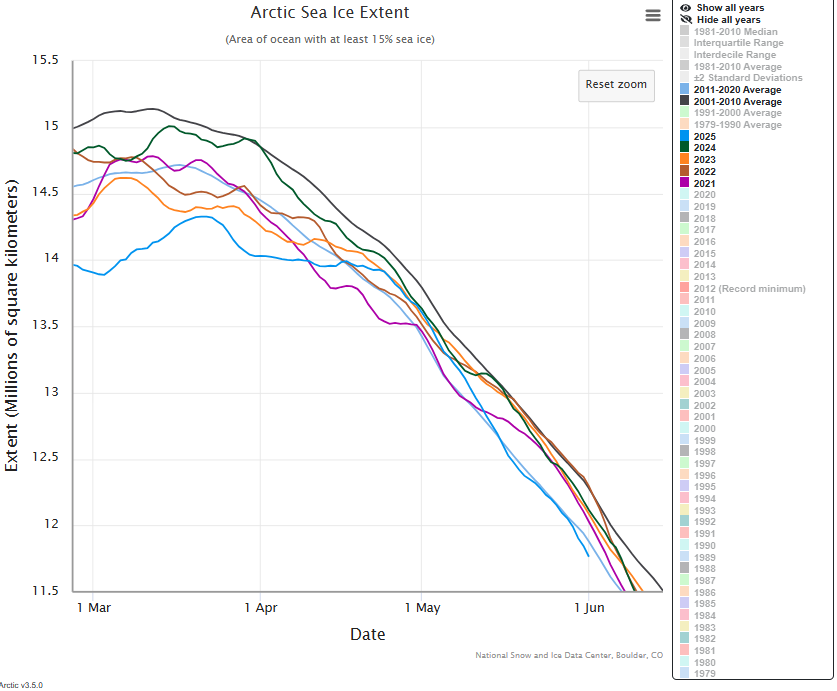

The fact that the 2025 line is below the previous decade average is not significant. To illustrate that I am adding another image which includes the lowest five years data lines from that earlier decade, all of which are lower than 2025.
Select image to enlarge.
I think it is fair to say that with all of the most recent years (half the current decade) fielding more ice cover than the lowest half of the years of the previous decade, it is likely that at the end of this decade we will find that the past expansion of melted sea ice has been halted. It may even be possible to say that the melting of sea ice is retreating. But we will need to wait another five years to conclusively claim that.
I did have one more topic I want to discuss.
Quite often now, I am increasingly seeing online information which points to a reinvigoration of opinion on climate change which is tending to give greater credence to the historical facts which I have been trying to unravel from the general false discord of climate treatments bundled together into an alarmist concoction to scare the bejeezus out of the global community, and which to a large extent still holds sway over the befuddled minds of the majority today. Soon perhaps will come a dawning of reality to the subject. And won’t there be some red faces, and perhaps some major reincrimination when that realisation happens, for all the hullabaloo and wasted time and effort, not to mention damage, that has resulted from it through the actions taken – wind farms, PV farms, EVs, net zero, alienation of fossil fuels, etc., etc. – in vain attempts to try to prevent its non-existent effects. Just to further line a few over-rich pockets.
Basically, there is no emerging climate catastrophe. Everything is just normal. It is just a ‘normal’ condition that we warm and cuddly humans have not so far encountered in our now comfortable (for some) quite short sojourn on planet Earth, in terms of the longevity of the history of climate factors which have kept our home planet more or less stable throughout that history – interspersed occasionally by external disturbances, the like of which we have also never experienced. That does not mean this condition, under which we have lived and grown to civilisational status, is new, or dangerous, or deadly, or something that we caused, or something which needs our attention. We need to accept that whatever it is we are now experiencing, we are not responsible for that. It is not a ‘first’, and it would have occurred, in fact it has been building for more than a hundred thousand years in the most recent iteration of cyclic patterns, whether or not we or our predecessors were here to witness it. And has done that for many times and different frequencies over the past many millions of years. Also, believe it or not, there is absolutely nothing we can do to stop or prevent or change any of this planet wide sequence of events from happening. We just need to be ready to adapt, and/or (for some of us) to move to some better, more safe, and more ambient locations on the planet, when and if good sense declares that is necessary for our comfort or survival. Not everything is a do or die situation. But if death threatens us where we are, there will always be more ambient locations on the planet within the tropical zones, for safe habitation. Some of them will be new areas, greened by the increasing levels of CO2 – like the Sahara (set to be no longer a desert), and much of Australia, and other similarly current barren lands North and South of the Equator.
You may quickly realise that this will quite possibly entail the removal of national identities, associated with where we now live, from the human psyche. We will no longer be ‘American’, by which I mean USA (which national territory will be under several ‘miles’ [their term] of ice cover), nor ‘African’, nor ‘Asian’, nor ‘Russian’, nor whatever. We will be ‘mankind’, in the same, perhaps less spacious but more verdant boat, still sailing the oceans of time and space. And we will need to get along together – or we will likely perish. And, if we do make it – by some mysterious stroke of luck, and with the opportunity to begin again the path to civilisation – there will be no ‘rulers’, or ‘rich’, or ‘poor’, or ‘old’, or ‘sick’. Or ‘priest class’, or ‘security class’, or ‘career’ class, or many other adjuncts of modern society. All those things will have passed in the transition, as modern society collapsed in what will become the dim, distant past.
It bears some major consideration, does it not? Of course this will not happen overnight. Climate change is almost timeless in human reference. Knowledge of our times and, importantly, ourselves, will have long been forgotten, and disappeared, by then. This new world, this migration, this coming together of humanity, is not for us. We may feel nothing other than a slight cooling of the weather. The process of temporarily raising the global average temperature by 5-6 °C took place over a period of some 17,000 years. To return once again to the bottom of that scale, in order to begin again a new cycle will take five times that long, or roughly 100,000 years. In other words it will be a slow cooling of roughly 1 °C every 20,000 years. The danger is, as I see it, the humans alive through that period (can you count the generations?) may not even notice such a small change in their own short lifetime.
And we have allowed ourselves to be led into believing imminent catastrophe is upon us? Our descendants, if such there are, will view us as primitives, led by the nose, stripped of all sovereign dignity and freedoms by unprincipled globalist dictate and doctrine, to a life of purposeless drudgery for experimental purposes and eventual disposal. You think Guantánamo Bay and such places are just a one-off thought bubble, reserved for ‘terrorists’? You don’t see that COVID, the war on ‘terrorism’, the impoverishment and subjugation of whole nations, and that ‘constant war’ is a doctrine of the most evil, malignant, cesspool of unhinged globalist psychopaths in the history of man, not a defence of democracy, or that the distinct deprivation of your health and sanity are not the work of those same lunatics to achieve the same unified results?
What fools we are.
But it doesn’t have to be that way. We just have to wake up and fight for what we know is good and true.
At this stage, it is not too late. Can you feel it?
 Not Something Else
Leave a comment