
End of April/beginning of May. It’s time to update the news on Arctic Sea Ice, and this time there is really something good to say. Not that anything so far this year has been really bad for the overall picture.
I think it is clear by now that 2025, due to a very low start for ice level at the beginning of the year, has seen the lowest rate of ice formation over Winter across the whole of the forty five (+) years of satellite recordings of ice levels. Not that that was very detrimental to the overall result of averaging the now five years of the current decade, measuring tens of thousands of Km2 less ice than in the previous decade for the first three months of the year (last year those three month’s averages saw positive gains, not less ice forming).
The picture has changed this month, quite drastically. See the image below. It is quite remarkable really, and perhaps unprecedented in the satellite era. Climate anarchists were quick to jump on the ‘lowest ever’ ice levels of the previous three months (not strictly true anyway), but I will wager they will not have much to say about this recovery by the end of April. So, usually after the end of March, sea ice levels begin to plunge into the ice melting season to the peak Summer melt over the next six months. This year however, from the last few days of March to the last week of April, the ice level remained at an almost straight line, hovering around 14 million Km2 of coverage. The level is falling now of course. It could not do otherwise. But take a closer look. I have included both the previous decade (2011-2020 – smoky blue line) average data line and also the decade before that (2001-2010 – black line). Every single year so far, of the current decade sits between those two decade averages. Remarkable! But also see that 2025 (between the green and orange lines), is now in second highest ice level for the current decade. And those three lines represent the most recent three years of records. Are you getting excited yet? And this is supposedly a difficult year, with that useless clown Guterres, at the UN podium, declaring a ‘Boiling Planet’. How ridiculous! There is obviously an evil scheme afoot to get you and me to believe we are in danger from climate effects. Personally I don’t buy it. I hope you don’t either.

See how close we are to breaking into the region we were at more than two decades ago (black line)? Not that that means much at this time of the year. May and June are months where the data always compresses into a narrow band of temperature results. Except for the fact that none of these results are seen below the previous decade average, which they have always been in previous decades. This is a good sign that we are on track for a decade average (not publishable before early 2031 – waiting for data) that will be hovering around, or even mostly above, that smoky blue line you see there for 2011-2020.
When that happens, let’s hear then the climate alarmists cawing their anarchist fables. They will simply be laughed off the stage – or far worse, for the troubles they caused.
I have updated my spreadsheet to include the April results. See the updated spreadsheet below. Also, I corrected the data value for April 2024, having fallen into my own trap of recognising the correct end-of-month day for what is a leap year. I also added some shading in some areas, hopefully for greater clarity.
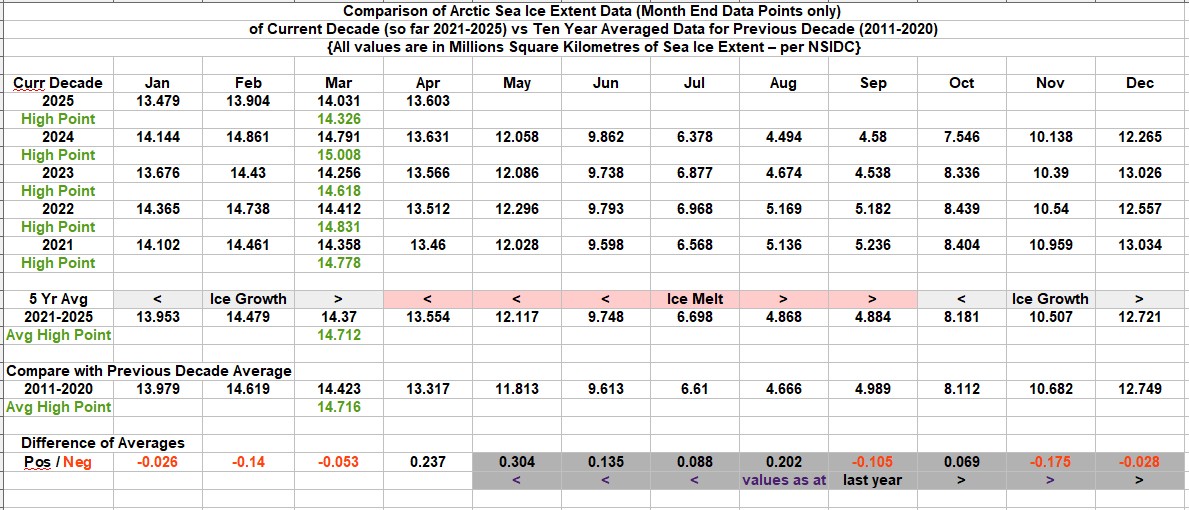
That is all I wanted to say here, except to point out that the Difference of Averages result for April shows there were 237.000 more Km2 of Sea Ice coverage in the Arctic, on average for this decade so far, as we now enter May 2025, than at the same time over the previous decade. Not only that, but it looks like we will see at least four more months with similar positive results, following this one. Have you grasped the import of that?
It means the generally, almost universally now, expected increase in loss of Sea Ice has not only stopped right here, in the 2020’s, but it appears to now be in reverse – Sea Ice gains being reported.
I am almost beside myself, with glee, at that thought. You probably should be too.
 Not Something Else
Leave a comment