
I said I wouldn’t report further on Arctic sea ice before month end, but something quite unusual, in fact something unprecedented has occurred, which I thought worth noting.
Anyone who has been following the Arctic Sea Ice story would know that the picture for over-Winter ice formation in 2025 has been anything more than laggardly, from an initial start-year low point – though nothing much worse than the low points of the previous decade, viewed year to year, a practice I generally deprecate. So, why the fuss?
Well, in the last week or more, something not seen before, at least in the satellite era, has occurred. It may cease at any time, of course, as the ice has to begin melting as we progress toward Summer. That usually begins around the end of March, beginning of April. This year a new phenomenon is seen.
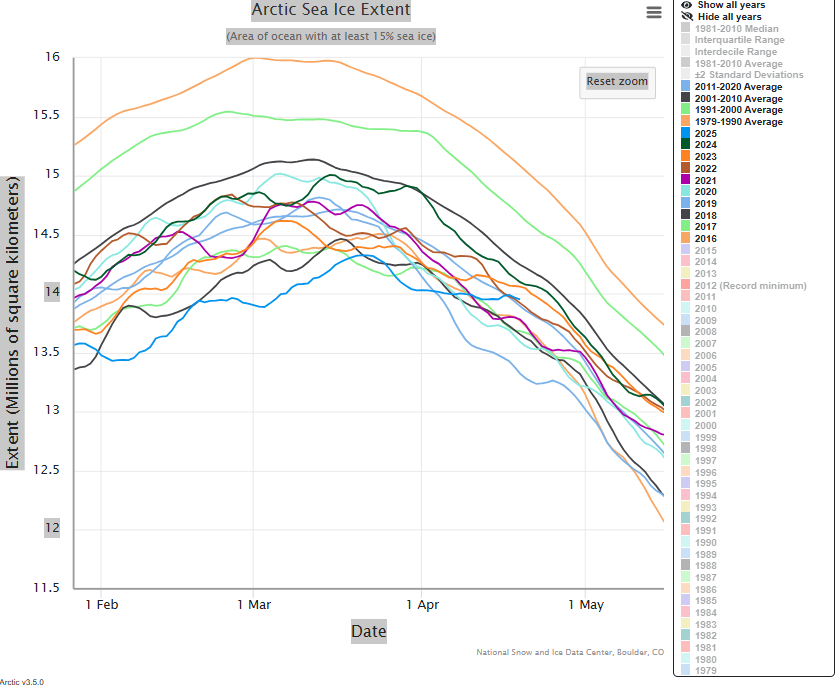
This year the sea ice has more or less held its level as it was first recorded back on March 30. Abd we are now three weeks into April. That is kind of amazing. Like I said, it has to begin melting some time but for the last three days the level has exceeded the average sea ice level for the same dates as was recorded as being the average for the previous decade of 2011-2020. So it is marching on, though the likelihood of it reaching the average for the decade prior to that – that of 2001-2010 – is small, it could potentially do that before the end of April.
In the accompanying image I have included all four decade average lines since satellite recording began, and also the now five individual years for the current decade plus the last five from the previous decade. A period of the last ten years, including this one – to give further means for comparison. The selected years and the decade averages are shown in bold withing the legend at right of the image – which, incidentally, as always when I do this, are taken from the interactive charts provided by NSIDC
Something to notice:
All five years, 2020 to 2016 (from previous decade) plus the next most recent year (2021), show less ice present from now to the end of April than the most recent four years (2022 to 2025). Check it.
That, to me brings hope, marginal for now, but it has to start somewhere, that the tide has turned for what has obviously been fast increasing ice melt in the Arctic for the past four decades, to a complete stop. Not a stop in ice melt. Melting ice is something that will always happen every year on a seasonal basis, but a complete stop in the increasing volume of that natural tradition. And perhaps the beginning of a reversal to that trend. That is why I am studying this so closely. It is my belief, based not solely on this activity, because this is just the natural outcome of what is so inarguably built into the planetary history of Earth’s climate movements. And it is a very good indicator that the warming period of the past 17,000 years which has marked the rising of modern humans, is coming to an end – as always expected – and well known to science and all rational scientists – to occur round about now.
For more, we will have to wait. But I think, that for the first time this year, we will see a positive result for end of April sea ice levels.
 Not Something Else