
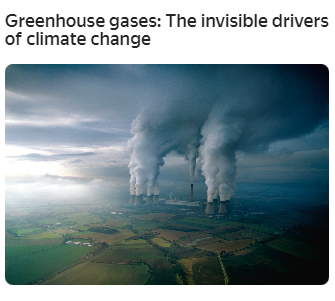
The image at right was taken from a weather page on my Yandex browser today. It, like all other use of so-called ‘greenhouse gas’ images, is rather puzzling.
If greenhouse gases are invisible, and I suppose that is true of the various gaseous elements included in that fictitious grouping, then why the need – a constant need in fact – to always depict the supposed problem such gases are declared to pose, with images of smoking/fuming chimneys and cooling towers from which are emitting vast clouds of extremely visible aerosols (mostly water-vapour I suggest) and whatever other particles they contain? Are you able to give an intelligent answer to that? No? Then why do they do it?
I will tell you why. Be aware that I am going to use a now uncommon phrase in this description. The phrase is ‘an air of authority’, which means ‘an affectation (pretense) of officially approved reality’. Watch for it. It is split.
There is no such thing as a greenhouse gas. It was a sciencey-sounding name made up to give an air (which is a real name of a real mixture of gases – including many of the so-called greenhouse ones, albeit in such minor quantities that they could never actually effect anything in nature they were not meant to do) of authority to a disingenuous story also made up to fulfill a need to get the world all hyped up about something – a supposed climate effect – which also does not exist. It worked pretty well as a ploy to deceive humanity, didn’t it? In spite of all the lies and sciencey-sounding descriptions. I was myself at one time deceived by it. I now understand the picture. And I am not alone. Nor was I the first by any means, though I did arrive at that conclusion by myself and through my own study. By doubting things that did not make sense. A great many people now are also aware that the climate warming myth carries no weight. And a great many of them are scientists – who probably always knew, but had mortgages and family to support. It is a difficult and lonely thing to fight distortions, until sufficient like-minded mass is seen.
As for the world? Maybe it is now too late to change decades held opinions. They will though naturally erode over time, with relief that they somehow managed to survive some mythical event. Until, of course, the universe through which we continually travel, along paths which every second of time have never been trod before – in all of history – let alone that brief flicker of humanity’s span, throws some real catastrophe our way, in the form of one or several massive cosmic bollides or other space oddities we have not hereto encountered.
Ok, enough of that – it may never happen – let’s get sciencey.
I have here, an illustrated essay from SciTechDaily – November 26, 2019 (almost 5 years ago). It is “Written by Jason West, Professor of Environmental Sciences and Engineering, University of North Carolina at Chapel Hill”. The essay includes a fairly short video and some data charts mostly from NASA. But of course, it inevitably uses some erroneous or misleading arguments. Something we have come to expect from modern academia, is it not?
‘Wait, the Atmosphere Is Only 0.04% Carbon Dioxide. How Does It Affect Earth’s Climate?’
‘Erroneous or misleading arguments’, I said. These include:
“Ice cores from over the past million years have shown that carbon dioxide concentrations were high during warm periods”. Not so, not so. There is no correlation in the data from the past which would indicate CO2 as being responsible for periods of warming. In some historical periods, temperatures have gone up – before, not with, increases in CO2. In other periods, temperatures have gone down as CO2 climbed. And vice versa. It is nonsense to claim CO2 is responsible for global warming.
Additionally, following on from the above quote: “…carbon dioxide concentrations were high during warm periods – about 0.028%. During ice ages, when the Earth was roughly 7 to 13 F (4-7 C) cooler than in the 20th century, carbon dioxide made up only about 0.018% of the atmosphere.” Oh what folly! So, the good Professor thinks (is this a standard for modern US Academia?) that 280 PPM (Parts Per Million) of CO2 is actually high – when it stood at 310 PPM at time of writing, and sits not much less than 450 PPM today? But, in the not too distant past, did not CO2 levels reach 2,000 PPM and even further back over 3,000 PPM? Those figures representing 0.2% to 0.3% of the atmospheric composition, compared to the 0.045%, of CO2 in the atmosphere, at today’s levels. He is not thinking very clearly, is he, viewing everything in context?
Also, from the above quote, the difference between peak warming, peak cooling, over recent inter-glacial periods in recent times (not to be confused with the overarching extended general cooling trend of at least the past 50 million years), is stated to be 4-7 C. I always use the range 5-6 C for this same factor. A degree either side doesn’t concern me, but I don’t see it in the data – which I obtain from graphical charts. He may have access to the raw data figures to work from so I am not going to quibble over that. It is no big deal. Inter-glacial warming always operates within that range – which is exactly why I can insist that the current temporary warming over the past 17,000 years has reached its limit, and will now begin a slow descent to the next glacial event. Put that in your pipe and smoke it, climate alarmists.
“Today the level of carbon dioxide is higher than at any time in human history.” Poppycock, I say. Even in the past 50 million years there have been times when CO2 levels were at least 4-5 times as high as today and up to 10 times higher than they were only several hundred to a few thousand years ago. And, while I don’t plan to expand on this, here (I have done that elsewhere in the recent past), I can say with honesty that this is exactly why we now have deserts in many places around the world where no deserts existed, not too many millions of years ago. We need at least 2-3 times as much CO2 that we have currently. But we (that is the planetary ‘we’) are much better off than we were just a few recent millennia into the past. And we are headed in the right direction – no thanks to the stupid, but thankfully entirely ineffective human activity, to do away with carbon.
There are other things to argue about in this piece, but I think I have done enough.
 Not Something Else
Leave a comment