
Consider this…
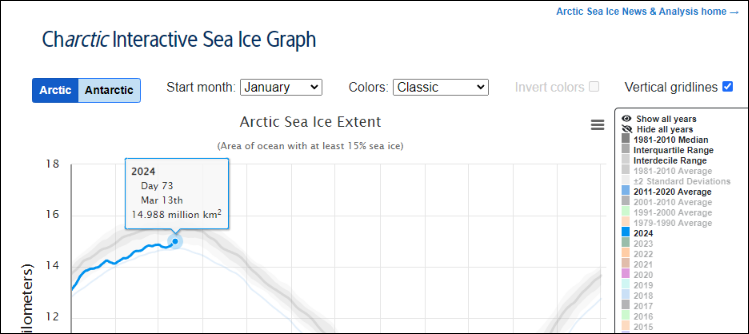
Note: All diagrams in this document are extracted using the NSIDC Charctic Interactive Sea Ice Graph, where you too can ‘play and play all day’ if you wish.
In the first few days of this year I predicted that it was possible for us to see a growth of Northern Sea Ice in the Arctic polar region with up to some 15 million Km2 classed as being ice covered. Well, we are now within spitting distance of that, to use a phrase not usually heard these days, as shown in the chart above (the brighter blue line) along with the average of all years in that decade (smoky blue line). I do not care whether it actually reaches the full 15 million, the point has been proved I think.
In the previous 2011-2020 decade, that happened four times, and I have shown this in the chart below, along with the same blue line for 2024 as above. So, what is the point? Well, and I hinted at this in a previous post, if there is some ongoing climate catastrophe eating away at our planetary safety harness, one would expect it to keep on getting hotter and hotter and there being less and less ice either generated or to melt across the years. This is patently not so, as I will endeavour to show.
OK, I grant that there are still six years plus the current in which the situation might change that outlook, but I think, and I have good reason to believe, this will not eventuate.

So, what can we say about the current decade so far? Take a look at the chart below. It contains all the data so far for the years 2021-2024. Two of those years, ’21 & ’22, produced less ice melt than the average for the previous decade. Last year, vociferously touted as the hottest year on record, with ‘boiling oceans – phew!! – was actually an average year for ice melt, except for a 3 week period in September where it marginally produced a slightly higher than average ice melt due to some late summer heat, but nowhere as severe as other years in that decade (as you can verify for yourself from the chart above – where the 4 million Km2 line of remaining ice was crossed twice). So, just to make it clear, 2023 was a remarkably average year (for the decade), in spite of what officials (of mostly dubious quality) and the media (of exceptionally dubious quality) tried to make it into for public consumption.
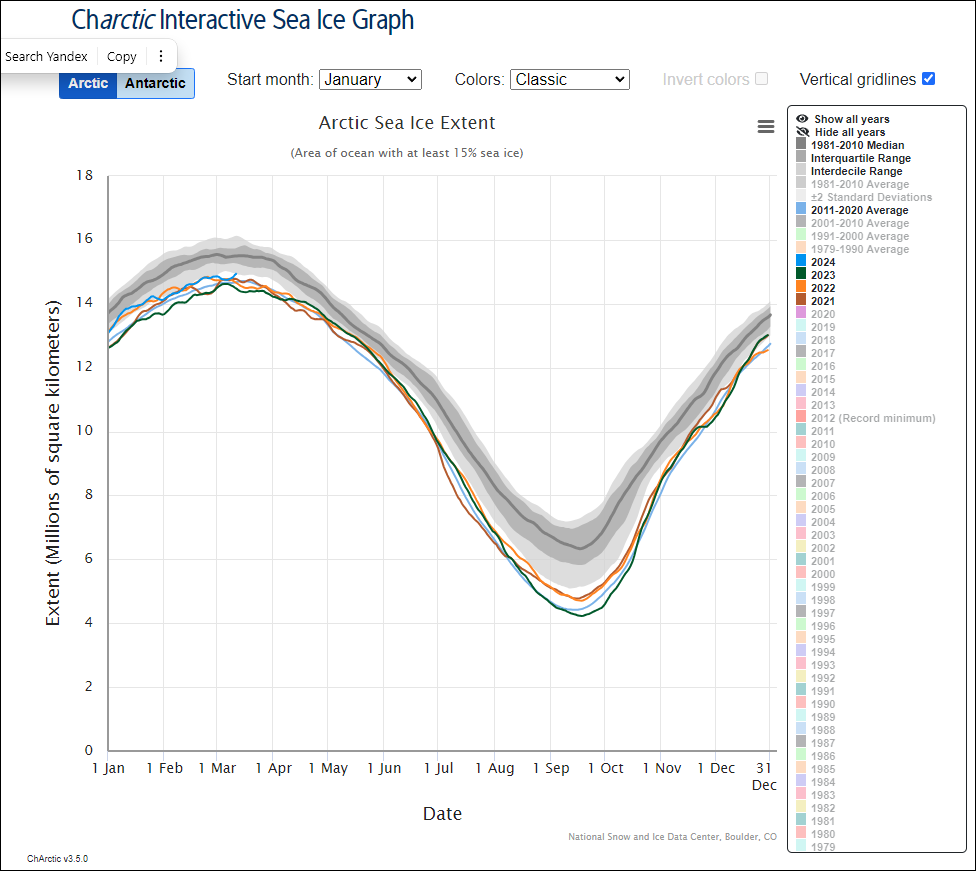
I will make another prediction now. The northern ice-melt season of 2024 is going to be of considerably less than the average severity for the previous decade. I can make this prediction with some confidence, because there are a number of precedents for this situation. Take the years 2012-2013 and 2020-2021, where in both cases (which are not isolated) a vigorous melt year is immediately followed by a considerably less than average melt year. Now, it may not be quite so noticeable for 2023-2024 because 2023 was not an outstanding melt year, but I think the principle still applies.
I want to make one further point. Over the slightly more than four decades that we have had the advantage of satellite data recordings to assist our growing body of knowledge of such things as Polar ice statistics, every succeeding decade since the late ’70s has produced charts showing an average ice-melt situation over the northern summers which indicates a considerably higher rate of melt over the more than 40 year period. It also shows the greatest amount of annual ice-loss from this process occurring over the past two decades, which make up the 21st century so far.
I believe, and there is growing evidence for this, some of which I have attempted to show, both here and in other writings, that this – which could be described as catastrophic if it continued – has now stopped. It will, having stopped, gradually turn around and begin to reverse direction. In other words we can expect northern ice to begin to grow, if not this decade (which will be proof of the stopping), then during the next (which will be the proof of the turning around). I can make this declaration on the basis of known planetary cooling-heating cycles and, not least, on the wisdom of President Putin and his advisors who, having seen the benefit of an open Northern Sea Route, for trade and general access, are building a fleet of very powerful nuclear-powered ice-breaker vessels to ensure such access remains available for use across future times.
Fiddlesticks to those who are mired in brain-cloying visions of an overheated world. Nothing of the sort can be expected to occur. At least not for many millions and possibly billions of years. We will all be long gone by then.
 Not Something Else
Leave a comment