
The haughtiness of man is astounding. The haughtiness of his thinking knows no bounds. And while man has always thought of himself as a unique being, created by and in a ‘special relationship’ with ‘gods’ who gifted him with the capability to think in those terms and in all of which there may be elements of truth, it is in only the most recent of times – as he has mastered the development of technological wonders far beyond the wildest dreams of his ancestors – that man has formulated and progressed this concept to the point where he sees himself as destined and fully capable of mastering and harnessing the natural world to which he has heretofore been confined. Even to extending that mastery, with the aim of breaking that confinement, to the wider universe. Of which, by discovery, he knows the world he inhabits is but an infinitesimally small and insignificant part.
That is an amazing journey of achievement and growth of ambition for a small, weak, mammalian creature – compared to the status of many of his fraternal fauna. A species ill-fitted to survive the environment in which he must live – except when that environment, or parts of it at least, persist for long periods of time within a fairly narrow band of temperate climate conditions. Conditions which he has now convinced himself are about to rapidly change to the extent of becoming for ever unsuitable – unless he takes matters into his own hands. A classic psychodrama built on self-realised myth and without taking into account the natural order. An ill-considered situation designed to elevate himself above nature and to prepare himself for the next great leap. What could go wrong?
And so man must worry about and concern himself with a range of issues that could easily see him deposed or even eradicated from his seemingly elevated position as apex lifeform. One of those issues, as I have already mentioned, is that of climate.
I tried in an earlier writing to explain how climate issues are not for man to concern himself over. Partly because the stories he is being told about climate change are falsely based – and always were, even though I was myself taken in by them in previous years. But mainly because, try as he might, there is no way for mankind to alter or affect the global climate, for good or ill. We have not lived as a species on this planet long enough to have experienced the much greater levels of heat or cold that persisted before our times – or those of our hominid predecessors. But there was animal, even mammalian life, with traces of even hominid lines in some of those times. And some of those earlier life-forms have persisted into modern times. Proving that life can go on in conditions very different from those narrow banded ones of our own experience.
The personal epiphany which turned me around coming from the rather abrupt tactical, 180° change, which saw the human global elites – who previously and for many years, went to great efforts and expense to deny there even was a climate change issue – to their new position of demanding sacrifice from all while they muster forces to ‘combat’ the climate beast, which now poses a catastrophic threat to our existence (according to them and their bought lackeys). Always suspicious of the motives of those who have sought power and leadership authority over the majority, this directional change gave me reason to suspect the truth of the climate issue. If they support it, it cannot be true. I found the achilles heel of the argument. The climate issue is based only on the past 150 years of human history. Everything else being confined to the background role of ‘pre-industrial times’. The projected effect being to focus blame on errant humanity. That’s us, you and me. The desired result to make us willing and docile followers in order to somehow assuage our imposed guilt – giving away our freedoms and our wealth (such as it was) to further and support the common cause and the ‘battle’ ahead. And like the dumb fools we are, that is exactly what we have done.
What I aim to do here is to look back much further than the 150 years to ancient and pre-ancient times [500 million years, with a focus on the last 65 million, should give us a good picture I think] to try to uncover the reality of what has occurred and to pinpoint the events which really caused changes in Earth climate and which are in fact fully responsible – without any assistance from us humans – for the climate we see today and the reasons for the real directional pushes to which it is subject today and into the future.
That is a huge task for a few pages of print, but I think I have done it (at least to my own satisfaction). Read on and form or adjust and incorporate, your own opinion. There comes a time in the building of a piece like this one where the author, not doing it for money, reaches the point at which the making of any further points or adjustments becomes counterproductive. I have reached that point, so I offer this as what it is – Warts and all.
Global Warming Timeline
Take a look at this portion of a timeline history of planet Earth…
800 million years ago to 550 million years ago
Glaciers covered the oceans as well as the land, killing photosynthetic algae that lived in the ocean. With algae in small numbers they were able to remove only a fraction of carbon dioxide from the atmosphere. With no check on its accumulation, carbon dioxide increased in the atmosphere, causing the Greenhouse Effect. The Greenhouse Effect ended the Late Pro-terozoic Ice Age roughly 550 million years ago, inaugurating a new warm period.
350 million years ago to 280 million years ago
The lush plant growth of the Carboniferous Era confirmed that the climate was warm and that carbon dioxide, essential for plant growth, was abundant.
The continents gathered into a single landmass called Pangea. Because it was near the equator, Pangea’s climate was tropical.
135 million years ago to 65 million years ago
Temperatures soared 20 degrees Fahrenheit warmer than today’s temperatures during the Cretaceous Era.
Forests covered Antarctica. Ocean currents again carried warm water to the poles.
An enormous meteor impacted Earth, ejecting a gigantic cloud of debris and dust. It ignited widespread fires, which pumped ash into the atmosphere. The debris, dust, and ash blocked out much of the sun’s light, chilling the climate. So severe was the reversal in climate that the dinosaurs and a large number of marine species, unable to cope with the new conditions, perished.
55 million years ago to 35 million years ago
Temperatures declined 20 degrees F (11 degrees C). Glaciers formed on Antarctica.
The climate was again warmer than it is today. The water from melting glaciers flowed to the oceans, raising the sea level 60 ft. (18 m.) higher than it is today.
The climate cooled yet again and glaciers once more spread across the continents, plunging Earth into its most recent ice age.
The glaciers were in retreat, temperatures rose nearly 15 degrees Fahrenheit.
Temperatures during the Younger Dryas fell ‘to’* 50 degrees Fahrenheit in only a decade*
Temperatures peaked at 2-3 degrees F (1-1.5 degrees C) above current temperatures. The climate remained warm and wet for another 3,000 years.
The Medieval Warm Period rewarded peasants with bountiful crops. With food in surplus, human population increased.
Chronology (Global Warming)
*Correcting errors: The correction – made by this writer – in the section ‘12,900 and 11,500 years ago‘ of a fall ‘to’ 50 degrees Fahrenheit. It was a correction necessary to make sense of this otherwise false statement. The temperature 50°F is equivalent to a temperature of 10°C which is the lowest average global temperature ever known in the last 550 million years. For quibblers, I am prepared to admit perhaps a single fall to 9°C, which I consider to be neither this or that, in this context. A drop ‘of’ 50 degrees of Fahrenheit temperature is absolute nonsense. As is the statement that this occurred ‘in only a decade’. It took around 110,000 years of gradual cooling to fall from the previous high (the Eemian Peak) of around 15°C to that low point. Since when, that 5 (or 6)°C fall has been recovered in full as at the current year of 2023, now standing at I think 14.7°C last time I looked. But that 5 (or 6)°C rise took several thousand years to achieve. As I will explain later, there may be another degree or two of temperature rise to accommodate (and get used to) before it begins to fall again – as it inevitably will.
The above timeline, described as a ‘chronology of global warming’ is in fact, on the contrary, a picture of global cooling. For the past 65 million years – as noted in that timeline – our home planet has been on a trajectory where a continuous cooling of its surface temperatures has prevailed. A trend which – despite the frantic arm-waving and hullabaloo of climate extremists, wayward or confused scientists, and greedy globalists – keen to make a quick buck out of it and/or impose restrictive population controls, continues even today.
What Do Global Surface Temperature Records Tell Us?
The image below, covers the past 65 million years of our average global temperature records, as determined by various means – the information coming from recognised sources as the best our science community can provide – shows well that gradual cooling I just mentioned. There is no indication as to who prepared this image but I want to congratulate whoever it was as being the very best information to possibly explain both the immediate past and the present climate situation which has been so dramatically distorted to be out of all sensible meaning. All for undoubtedly subversive reasons to benefit others who have little or no regard for human welfare or that of other planetary lifeforms.
I will be referring to this image throughout the whole of this article, so for interest’s sake you will need to revisit it as we progress.
I used a similar image in my earlier article but this one answers some of the unanswered questions arising from that. Such as why the bumps and dips? And why the sudden changes in temperature oscillations? And why the sudden change of pace in the cooling in the last 5 million years? If you follow the red trend line through the image it will be immediately obvious where this is going. This is an excellent and informative chart with a timescale in millions of years and a vertical temperature scale of actual degrees Celsius rather than some abstruce and misleading anomalous data. Its only failure, in my opinion, is that there is no 0°C base point – which would have been helpful towards seeing how far away we are (and have always been, for at least the last 550 million years) from being a frozen planet.
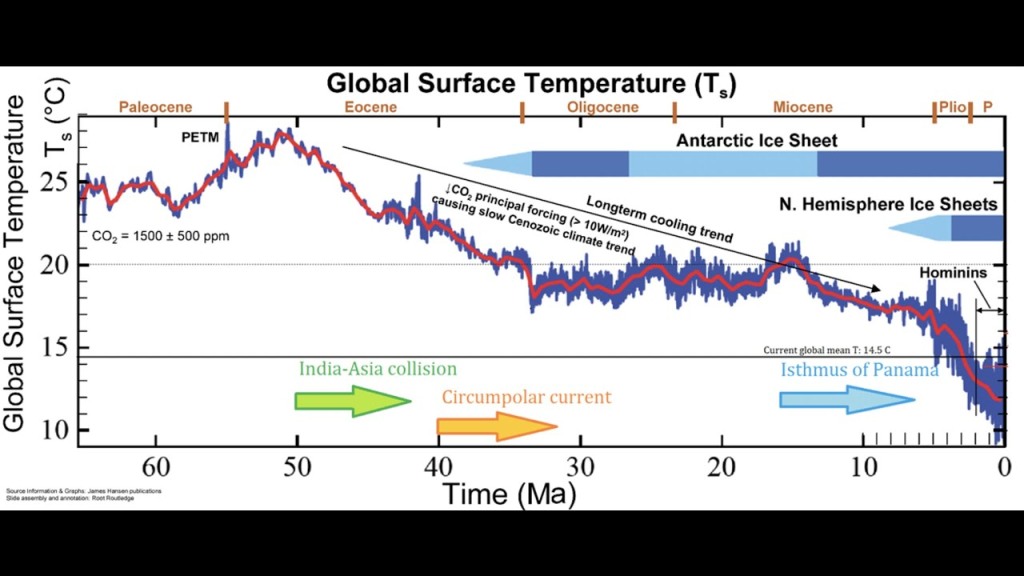
Incidentally, if you followed my previous article, where I introduced an image which spread the last 5 million years over a broader scale and allowed us to realise that there has never been, in the whole of the 65 million years we are talking about, a temperature rise or fall in the data greater than 5-6°C. Never. That gives me confidence to say the following…
The whole period of the civilisation of man, which has taken place since the end of the last ice age, some 13,000 years ago (an event which marked the beginning of the Holocene era), rising in temperature from around 9-10°C at the lower end to our current almost 15°C of relative warmth, has been an ~5°C rise so far. There have been many such rapid (as it may be described in geological terms) rises – especially in the past 5 million years. Many less than 5°C but none greater. The previous most recent one being the Eemian event – some 130,000 years ago. All such rapid rises, after reaching their peak, have been followed by a gradual fall over roughly similar periods, relative to the size of the rise, and never going below the 9-10°C mark.
I see no reason whatsoever, why the current global temperature rise we are experiencing, should turn out to be any different to those of the recent past. As I have already said, there could still be another 1-2°C of rising temperature left in the system, but no more. And then the cold period will begin – and persist, in all likelihood, for another 120,000 years or so.
This pattern is likely to be repeated over lengthy timescales.
Author’s own opinion
Those are the most important statements I have to say. I chose to say them here rather than at the end so that you may see where we are going with this. There is more to add, including a scary proviso, but first the justification for making these claims.
So, nothing happens without a reason. Let’s discuss the points I queried earlier, bearing in mind that the past 65 million years has been replete with dramatic changes in the surface arrangements of our planet.
Just a million years before this chart begins, an epoch marking event occurred which saw the extinction of the apex planetary lifeform of the time, the dinosaurs. The cause being a violent cosmic intrusion which is well recorded elsewhere. I mention this only because it may have at least partially precipitated a string of events from the effects of which our planet may still be resonating. There has to be a cause of some sort for every effect, including the inarguable continued cooling of our planet. And that cause has to be something standing outside of and in addition to the gradual cooling of the Earth’s core (said to be at a rate of about 100 degrees Celsius per billion years) and also of any cyclic factors of heating and cooling in earlier eras of Earth’s history. In addition, that cause (or causes) must possess a far more physical presence and effective strength of impact than a small increase (well within the bounds of previous eras in our history) of some common gas which is essential to the development and continuance of life. The undoubted interference and unique skills of humanity to screw things up, also does not meet the required criteria as a cause for anything that could possibly place the natural world in any form of jeopardy – except in our own self-limited minds within the narrow bands of thought we permit ourselves.
There has to be another factor, and there is. It is nature itself, and whether you agree or not that nature has ‘being’, nature is well capable of looking after itself. In fact, I think, nature is trying to help us…
The fact that this late period cooling trend appears to have started with the PETM and may be breaking the patterns of more rapid changes signals that something is quite different now. There may be a number of coalescing factors at play which, when we should be plunging into rapid cooling (to which we would not be able to adapt) under the old paradigm of cyclic ups and downs, we are actually only gradually, mildly and generally non-violently living in a quite pleasant phase – perhaps the only time in the planet’s history that human forms could survive and thrive (except perhaps for being just a little bit warmer) – giving us the opportunity to prepare and adapt to an even cooler (by just a few degrees – not too much cooler I hope) and perhaps more stable climate than has ever been possible before.
Stick with me for a while longer and I will attempt to explain.
The Earth has barely had an uninterrupted moment since the dinosaur incident to recover from that episode, which also saw the continued breaking apart (begun some 200 million years ago) of the great super-continent of Pangaea, forming the current continental land-masses, moving and floating on their supporting tectonic plates (as we are told), more or less to the positions we see today. Such a dramatic period of activity may well (though again I can offer no proof) have been causal to the raising of various gases which are said to have inflamed the 2-3°C of heating, above the then prevailing conditions, featured in the PETM event (the major ‘bump’ to which I referred). That anomalous ‘bump’ raised average global temperatures from 23-25°C up to a 28°C maximum (Imagine what our current climate alarmists would have said about that, had they been there at the time). The whole episode taking place over a period of some 10-12 million years, and at the end of which the cooling trend resumed its slow fall with average temperatures of 22-23°C. You can see all this on the image above.
The Asia/Australasia Tectonic Plate Collision
Meanwhile, the huge tectonic plate bearing the India Sub-continent, soon to become officially known as Bharata, I hear (and playing havoc with the BRICS acronym) and also the whole of Australia, was thundering northwards at a rate of knots (currently reduced to a few centimetres per year), barrelling into the southern flanks of Asia from Indonesia all the way to the ‘Land of the Pure’ – Pakistan. Imagine the disruption such an event or series of events would have caused. And cause disruptions it certainly did, between some 40 and 50 million years ago. The raising of the Himalayan mountain range is the one major thing which comes to mind. But also it was at this point that more rapid changes in swings from warmer to cooler average global temperatures began to occur. And that has continued to this day, becoming something of which we now possibly do need to become concerned as a result of other events which I will soon relate. It should be noted that the oscillations from high to low temperatures beginning at that point [or should this be referred to as the amplitude of the variances (data which can be analysed statistically) – I’m not sure*]
* Analysis of Variance is a statistical tool. Perhaps we should be concentrating on this aspect – and its causes – rather than falsely claiming the possibility of such nonsense as runaway climate change – which remains but an unproven and very unlikely theory (except for mad scientists – such as those who form the Arctic Methane Emergency Group – an organisation now largely defunct since its dire predictions for 2016 somehow didn’t manage to work out so well).
But on those rather more important temperature oscillations, there appears to be a slight increase in the frequency of changes from higher to lower temperatures. Chiefly in the timing – and therefore the duration of the changes – but also, to a lesser extent, in the amplitude of the swings. Not regularly, but this is where a marked and not before seen increase in both these frequency factors begins. This is towards the latter part of the Eocene and on into the Oligocene era. It is fairly obvious that, as the time draws closer to our own, both amplitude and duration have altered dramatically. Why? Again the prior image provides clues.
The Antarctic Circumpolar Current
The next major event on the chain of climate changing disruptions, and it is a big event, crucial to the pleasant living conditions we now enjoy, would be the formation of the Antarctic Circumpolar Current, sufficiently described for our purposes by the linked article in Encyclopaedia Brittanica. From which comes the image below.
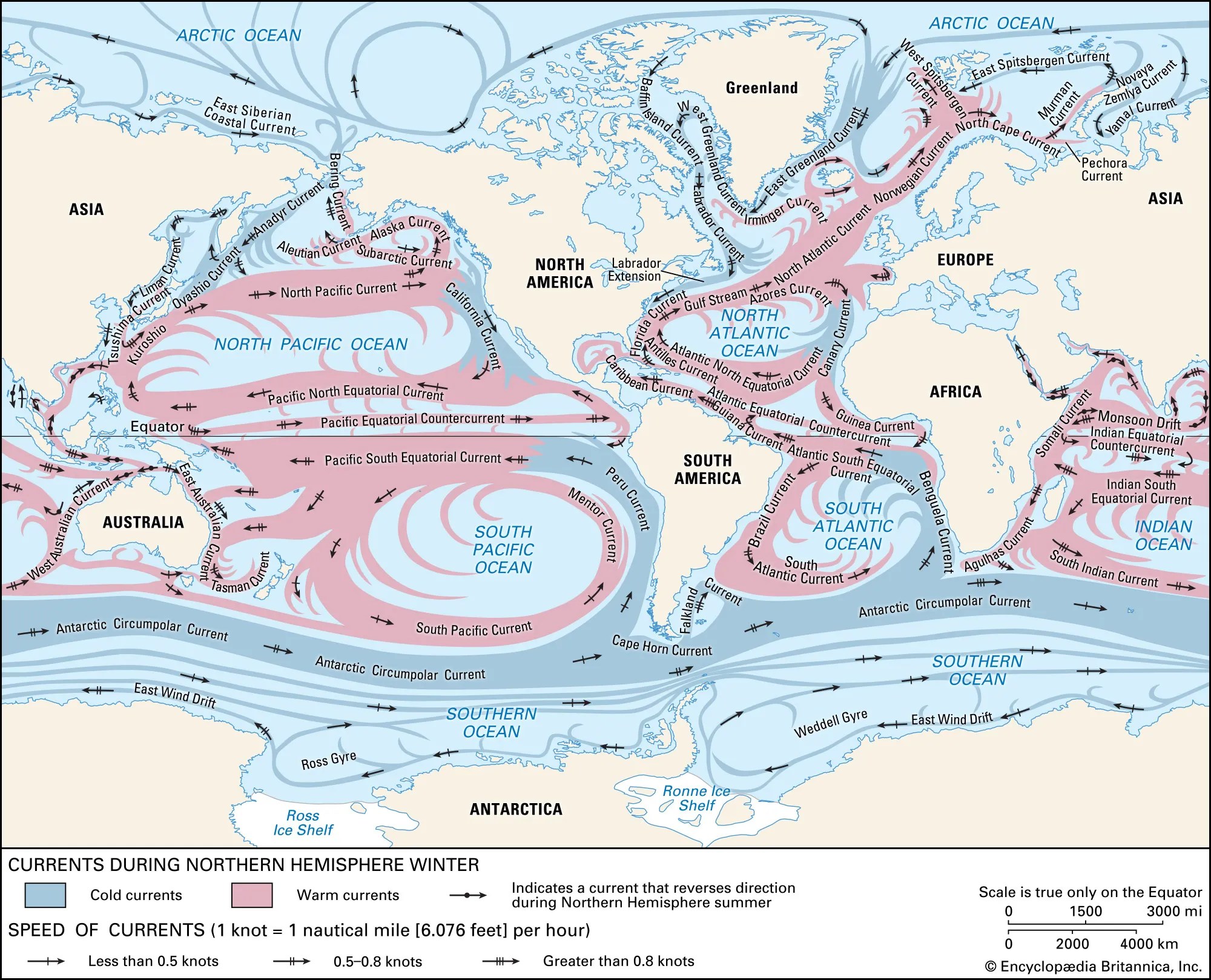
There is only one oceanic current which flows around the entire circumference of the globe, and this is it – the Antarctic Circumpolar Current (ACC). Otherwise known as the West Wind Drift, this massive volume of constantly moving water, has only existed for some 40 million years. Prior to that, at least during the time of the Pangaean landmass, which was a huge impediment to east-west water flows, the waters of the single ocean surrounding that …I guess it could be viewed as a huge island… would presumably have flowed around that landmass. And as it began to break up into separate continents from around 200 million years ago, fresh (in terms of ‘new’) water flows would have formed. Imagine the sort of chaos that period endured. We are either very lucky (so far) or we were serendipitously delayed from entering the scene until the relatively calm times during which we have existed on this planet. We should be grateful and treat the Earth with the respect it deserves – rather than doing our best to screw it up. Which seems to be our driving motive now – no matter what we claim to be doing.
It must have been that during those tempestuous times that new oceanic currents began to flow in the gaps between the diverging continents. And as the land-masses spread and cleared from being the impedimental blocks they were in times past, space was freed for perhaps the greatest circumferential flow of surface water anywhere to resolve a new path for itself to form the West Wind Drift or ACC.
What actual water flows were created north of the ACC and weaving their way between the diverging continental masses we are unlikely to ever know. The two American continents were, at that time, still unjoined and water flowed freely between what became known as the Atlantic and Pacific oceans. No map can tell us what exactly happened with intercontinental oceanic streams back then. But the ACC has apparently remained unchanged since it formed.
Luckily for us the ACC forms the bulk of the Great Southern Ocean, cooled on the whole of its journey around the world by its proximity to the adjacent frozen Antarctic continent. This was the reason, to a large extent I believe, for the up to 2°C drop in global temperatures beginning at the Eocene-Oligocene boundary, some 34 million years ago.
While we are talking about ‘icy’ things, it is interesting to note the following quote from Wikipedia –
The icing of Antarctica began in the Late Palaeocene or middle Eocene between 60[8] and 45.5 million years ago[9] and escalated during the Eocene–Oligocene extinction event about 34 million years ago.
Antarctic ice sheet
I think we can narrow it down a little closer than that, using the information we now have, to something in between the claimed 45.5 and 34 million years ago. During the Pangaea times the Antarctic land would not have been ice-covered (unless of course the whole global landmass was so covered). And despite many of the Pangaean maps floating around which depict it with a white covering (presumably for recognition purposes). But as it drifted away from other continents toward its present polar location, ultimately surrounded by presumably colder waters (or even sea ice), that would have logically been its beginning to ice over. The first image I presented also appears to concur with that premise. That would place the Antarctic ice at something between 34 and 38 millions of years, although I don’t see any reason to be pedantic about that – unless it is required for some other related context.
Note also when that first image – the 65 million years – suggests the northern hemisphere ice-sheets were formed. Given as only within the last 6-8 million years. There is a connection between that and our next port of call – via the Isthmus of Panama. But first, let’s look again at the question of the frequency and magnitude of the temperature variations and where they have led us during this period.
It is I believe, plain to see from the first image, that the formation of the ACC around 40 million years ago, that this event is causally linked with a relatively sharp fall in global temperatures of perhaps 2°C right on the Eocene-Oligocene boundary, followed by a 20 million year period of generally stable (within certain bounds) climate – followed by a minor and temporary bump back to the previous level – which can now probably be explained.
During this period of remarkable stability we can, though the scale is limiting to a proper investigation, see that the temperature fluctuations have grown in number (more of them per million years) and in the waveband of highs and lows (I’m trying not to be too technical here). You can see enough to be able to agree somewhat with that statement I hope.
With average global temperatures fluctuating between 18-20°C for such an extended period of time, it is little wonder that mammals flourished in many parts of the world. As did herbacious plants. I guess those two things are symbiotic. Personally I would have favoured that time of mild warmth in preference to the 14-15°C of the so-called ‘warm period’ we have now, all other things being equal. And while we have the potential for up to another 2°C rise to come, and the extra CO2 to produce the required greenery to make it pleasant, we won’t quite reach those halcyon days of the Oligocene era.
There is one final chapter in this story.
The Isthmus of Panama
If we look one more time at the first image I shared, we will note that immediately following the short perturbance which brought to a close the slightly cooler but stable era of the Oligocene, the general schema of gradual cooling resumed for a while until something else occurred which caused (remember there always has to be a cause) an abrupt increase in the rate of cooling at around 5 million years ago. That rate of cooling persisting right up until today – and unless something else intervenes to stop it, likely to persist for some time to come. I’m talking of millions of years, so nothing for you and I, or our children, or their children, or children’s children’s children, for many generations to come, to worry about. It will never reach the frozen planet stage. And in case it does look like that dire consequence may eventually be reached, I will leave a note to tell them exactly how they can avoid that fate – based on the already known cause.
And now, dramatically dispelling the whole myth of CO2 and human responsibility for the so-called ‘Greenhouse Effect’ (with all the accompanying nonsense that entails), here is the real reason (along with all the other factors I have written about today) for the current climate situation we are living with, both now and unfortunately into a much cooler future. Here is the final piece of the puzzle – The Isthmus of Panama.
There is some controversy over exactly when the Isthmus of Panama was formed. Can you imagine what the situation was prior to that joining of the two Americas? There would have been free exchange of waters between the Pacific and Atlantic Oceans – or whatever they were called back then. That is not a silly or ill-thought-out statement. There is good scientific evidence for the presence of hominids in the Americas, as also around the world, at least 2 million years ago and while suppressed by the scientific establishment (for their own reasons) also as far back as potentially 35 to 50 million years ago. Perhaps not in large numbers but sufficient to ensure a continuous line of human ancestry through subsequent ages. See the excellent book ‘The Hidden History of the Human Race’ (as a downloadable, 658 page, pdf on that site) for references to that.
But back to the joining of the Americas controversy. It is important to note that there were no gulfstream waters flowing around the northern Atlantic before that event. Nor around the Pacific or or southern Atlantic. I can’t imagine what the flows may have been nor do I have the time just now to research the question. I am sufficiently convinced by the few statements on the subject I have read and from which I will quote below. This is a sufficiently important issue for you yourself to do your own research on it. Of course I may get around to doing that myself later.
Take this statement…
“The reason we have the climate we have today is because the isthmus went up … this tiny, tiny piece of land affected the climate of the entire planet.” – A statement by Carlos Jaramillo, a staff scientist at the Smithsonian Tropical Research, to Live Science.
When did the Isthmus of Panama form between North and South America?
Note, and note well, that there is not a word about gas of any kind in there.
Here are a couple more statements from the same article source…
But exactly how many million years ago did the Americas link up? The “standard model” dates it to about 3 million years ago, while some more recent studies say 6 million to 15 million years, with “an initial land bridge” as early as 23 million years ago, according to a 2016 report in the journal Science Advances.
From same source as previous
…and something about that ‘Standard Model’ thing…
The standard model originated from research in the 1970s, according to the Science Advances study. That includes a 1978 study in the journal Geology that examined fossils from deep-sea cores; it found that marine species became isolated on either side of the isthmus about 3 million years ago. Over the following decades, subsequent studies reaffirmed this timeline, according to the Science Advances report.
From same source as previous
That was the scientific establishment holding their ground for the least controvertial story. I don’t agree, but hold the 6 million year option as the best fit for final closure, with a gradual build-up to that from around 20 million years, which seems to mesh well with the first image I used in this piece.
Conclusion
Ok. So I think I have said enough to dispel any concerns about ‘boiling oceans’ – an illicit cry, unworthy of any thinking adult human – or of ‘greenhouse effects’. For the current crop of humans on planet Earth there is nothing of concern in our general wellbeing that can be attributed to climate effects. Lots of other worries, but none of them climate connected – other than a loose association in the food production area. where far greater damage is being done by humans themselves through their farming practices.
The Earth will continue to get cooler over the long term (millions of years), after a brief period (I will explain that in a moment) where little more than another degree Celcius of planetary warming may occur.
Look! It will take, if past patterns continue, up to 120,000 years of gradual cooling from the coming high point of 15-16°C to get down to what has become the standard base level (for the past 550 million years – why would it change now?) of 9-10°C.
That is in the current 130,000 year cycle of one 10-12,000 years of rising temperatures followed by one 120,000 years of cooling temperatures down to roughly the same level from which it started. This is one of the most severe of those cycles, and we are about to reach its pinnacle of heating. Other cycles in the stream of such things are likely to not be so severe – reaching less elevated temperatures than we are experiencing and taking less time for the rise and fall. It is just our luck (good or bad, however you see it) that humanity was thrust into prominence here at this time, to live through this particular cycle. Whether that is by accident of fate or not, I leave you to decide.
Look! I wasn’t going to do this but I have decided to include here that image from my previous article which clearly shows the kind of cycle I am talking about. Where we are now, is at the top of the line at the far right of picture in the bottom frame (to the right of the arrow labelled ‘Holocene’). Our cycle began at the arrow labelled ‘Last Ice Age’. The falling temperature part is not shown because it has not happened yet. However you can get some idea of how it will play out by looking at the gradually falling line of the previous cycle immediately to the left of that – the one whose pinnacle is labelled ‘Eemian’. I hope that helps with some understanding.

As for the ‘brief period’ I mentioned, it has taken 13,000 years to achieve a rise from that base level to the current global average (and remember, all of these temperatures I mention, unless stated as a specific actual temperature, are global averages) of ~15°C – a 5 degree rise at a rate of 1°C per 2,600 years. It could take anywhere up to another 2,600 years to gain another degree. So, what I am saying is “don’t hold your breath waiting for it to happen”. It may of course occur in the next year or two. I’m hoping it takes longer, and stays at that level for quite some time. I don’t like the idea of things getting colder in any hurry. But let me explain the falsity of current climate thinking. They say there has been a rise in temperature of something like 1°C in the past 150 years (most of their charts, all of which cover only the past 150 years – as if nothing that happened in the previous several thousand years actually mattered – but I have just proved that it takes 2,600 years to raise that one degree they claim). It is just a matter of choosing the right starting point that suits your argument, don’t you see? When dealing with geological timeframes, the longer the time period the more accurate you conclusions will be. In geological scales, 150 years is a blink. An unrecognisable dot. It seems important to us now because of our proximity to it. But in the long term it has no meaning. Just as the whole history of modern man is so insignificant as to be completely ignorable at geological scales. While important to us now, in just another million years, if any sentient beings are around on this planet, all of our ventures will have been long forgotten and our effect on the planet completely unrecognisable.
But there is still one point to elucidate. The scary proviso I mentioned earlier.
Take one more look at the first image, with the red cooling trendline. At the plotted end of the line, on the right border of the chart, see that the median trend for the average global temperature stands at just under 12 °C. So, while the current annual average, which hopefully (and I know not whether this is true or not) is calculated from every measurable point on the globe taken at all (or a reasonable range of) times of the day, every day of the year, may be something around 14.7°C, the actual or calculated trend line sits at a 3°C lower value, say 11.7°C. Again, with the scale of the chart and without access to the data or method of calculation, I cannot determine how accurate the figures may be. But maybe it doesn’t matter anyway. Ballpark accuracy may be sufficient, the important thing being what, taken all together, they point to.
And what they point to is that there has been a distinct increase in the rate of cooling beginning some 5 million years ago. The dog-leg knee joint is clearly visible in the data plots. And guess what? That pretty much coincides with the formation of the northern hemisphere ice-sheets (Greenland, Laurentide, Cordilleran and various European) and also with the closing of the Panama peninsula – which shut off the water flow between the Atlantic and Pacific and presumably initiating the circulating flows, like the Atlantic Gulf Stream, in both north and south pools of both the Pacific and Atlantic oceans. I cannot find, and I don’t possess the necessary experience to determine a cause for the formation of the ice-sheets other than the continued gradual cooling of the global climate. Maybe it was something to do with the Panama Isthmus, I don’t know, but that certainly altered significantly the great ocean water flows and I suggest – as the evidence I reported in an earlier section also said – that this incident had a great impact on the global climate. The only clearly visible effect that could have been is the increased rate of cooling going on from that time and still in play today.
Let’s try to estimate the rate of temperature cooling from the present trend. Using my eyes I can estimate the trendline has fallen 4°C in the past 4 million years. That is a close enough estimate. It represents a fall of 1°C every million years. So, if nothing else changes in the meantime, the trend will sit at the 0°C mark (where frozen watery planets lurk) in around 12 million years, give or take.
Maybe we should do something about that. Those 12 million years will go by in a flash. Not that anyone I know would be concerned about that. But what could we do? Well, I could give that note I so playfully mentioned before to the relevant authorities, if I could identify them, with a plan to extend our species lifetime by a great many more millions of years than that, if we could return to the slower level of planetary cooling which once the world enjoyed. I estimate, using again my Mark 1 eyeball, that rate of decline was around 1°C in around 25 million years, which if actioned right now would give us 25 x 12 = 300 million years. A much more comfortable margin.
My only motive for playing around with these figures is to be able to say…
Why are we worrying about these things?
And, before I forget, what would we do to restore the situation? I hesitate now to suggest it, but isn’t it obvious? We need to destroy the Isthmus of Panama and let the waters flow again freely, adjusting the climate as they go. After first resettling the folk living there of course. I make no guarantees as to what the possible effects of such a move might be. Western Europe and the North American eastern seaboard might freeze again.
Oh, I forgot to mention. In the next 300 million years, anything could happen.
We could be the next dinosaurs.
Do you think we could stop that from taking place?
Don’t be silly.
 Not Something Else